

The “Kash Patel” Bollywood Video That Got Our Hopes Up
By J. J. Ghosh | 03 Apr, 2026
A video purported to be FBI director Kash Patel dancing turned out to be a fake. Why did we want it to be real?
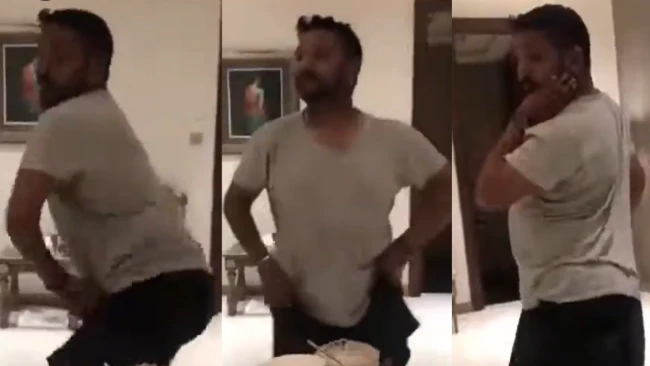
Many believed this dancing man to be Kash Patel
Last week, a video went viral. A brown-skinned barefoot man dances enthusiastically in what appears to be a living room, arms swinging, feet shuffling, fully committed to the moment, while friends cheer him on in the background.
The song playing is “Sun Sahiba Sun,” a romantic classic from the 1985 Bollywood film Ram Teri Ganga Maili. It is, by any measure, a charming video of a guy having a genuinely great time.

The video depicted a man dancing to Bollywood hit "Sun Sahiba Sun"
Abraham Lincoln once famously said “Don’t believe everything you read on the internet.” And yet, I didn’t question it when I read that the video was FBI director Kash Patel.
The reason that such a video would be out there made sense: Patel’s email had just been hacked.
A group calling itself the Handala Hack Team, reportedly linked to Iran, claimed it had breached Patel’s personal email account and accessed over 300 emails, photos, and documents dating between 2010 and 2019.
The Justice Department confirmed that the hack was legitimate.

Patel chugging beers with the US Men's Soccer Team after their Olympic victory
Since 2010-2019 was long before Patel entered public service, it made sense that he would have embarrassing content in his email.
But at the same time, any Indian American will tell you that the video in question was far from embarrassing.
In fact, on the contrary: many of us who have long taken issue with Patel briefly believed that he was more like us than we had realized.
Why It Could Have Been Him
Kash Patel is the FBI director who once vowed to turn the J. Edgar Hoover Building into a “museum of the deep state.” He is also the man who wrote a children’s book series casting himself as a wizard and Donald Trump as a heroic king.
Even his biggest advocates would likely admit that he is less interested in running an impartial Department that holds both sides equally accountable and has instead set his sights on punishing the President’s enemies.
He is, by all accounts, a younger and more energetic version of Donald Trump.
But he’s also an Indian American, a group squarely in the crosshairs of many Trump supporters who spend their free time calling us names and tweeting about our alleged lack of hygiene.
His full name is Kashyap Pramod Patel. He is the son of a Gujarati Indian-Ugandan father and a Tanzania-born mother. His parents married in India and emigrated to New York, where he was born and raised in a household that included his father’s seven siblings, their spouses, and six children. He was raised Hindu.
He is, by any definition, a child of the South Asian diaspora. The son of refugees. A kid who grew up in a Gujarati immigrant household on Long Island, surrounded by extended family, shaped by a culture that traveled from India to East Africa to America and carried itself intact across every border.
He has shared memories of sneaking out with his father for butter chicken at a Little India spot on 72nd Street, since his mother kept a strict vegetarian household — a weekly ritual he has described as one he still holds close.
Our community is by and large opposed to Patel. Over 60% of us voted against Donald Trump in 2024.
And yet, every one of us who grew up in a Desi household has lived some version of that very story.
As much as he may try and hide his background, we know that it’s there.
So yes — a video of Kash Patel dancing barefoot to a 1985 Bollywood song in his living room, surrounded by cheering friends, was entirely plausible. It fit. It made biographical sense. The song, the setting, the barefoot commitment to the moment — this is what South Asian family gatherings look like. This is what it looks like when the right song comes on and someone stops pretending they’re not going to dance.
The internet was not being naive. It was pattern-matching correctly against a real cultural background. The video just happened to belong to someone else.
Why We Wanted It To Be Him
Kash Patel has worked very hard to project a certain image. The gruff outsider. The street fighter. The guy who pounds beers with the US Men’s Olympic hockey team and posts the photos, who wears his toughness like a uniform.
His entire public persona is built around the performance of a particular kind of American masculinity — hard, loyal, unapologetic. Tenderness is not part of the brand.
But “Sun Sahiba Sun” is not a tough-guy song. It is a deeply sentimental song, the kind that plays across generations at Indian weddings and family gatherings, the kind that Gujarati households have been dancing to for forty years. Whoever the man in the video is, he knows this song in his body. He grew up with it.
Bollywood dancing — specifically this kind, barefoot in a living room with friends watching — is not a performance. It is one of the most universally shared expressions of joy in the South Asian diaspora. It is what happens at weddings when the aunties pull you onto the floor and you either commit or you don’t. The man in the video committed completely. There is no tough-guy version of what he was doing. You cannot do that dance ironically.
That’s exactly what made it such a potent fantasy.
If it were Kash Patel — if the FBI director had a video of himself fully surrendered to a 1985 Bollywood classic, barefoot and beaming — that would have been a glimpse of something his public persona almost never allows. The version of him that existed before politics. The Gujarati kid from Long Island, home at a family gathering, dancing because the song came on and he couldn’t help it.
The AAPI community has spent years grappling with the particular dissonance of Kash Patel. He is the first Indian American to lead the FBI — the son of refugees who fled a genocidal dictatorship, carrying a story that is genuinely and recognizably ours.
And yet he has spent his career in service of a politics actively hostile to immigrant communities, to people of color, to the very AAPI families whose story rhymes with his own.
That tension doesn’t resolve. But for a moment, the dancing video offered something rare: a version of him that existed outside of it. Not the MAGA culture warrior. Not the deep state avenger. Just a desi guy at a party, barefoot, knowing every step.
The video was fake. The longing behind the retweet was real.
We wanted to see him dance because we wanted, just for a second, to recognize him.
© 2026 by Asian Media Group Inc.
Many of us who have long taken issue with Patel briefly believed that he was more like us than we had realized.
Recent Articles
- Global Demand Surges for Anti-Drone Technology
- BYD Looks to Formula One for Fast Global Brand Expansion
- Europe's EV Sales Keep Growing As Fuel Costs Rise, Car Prices Fall
- SK Hynix Ships Samples of Next-Generation AI HBM Chips
- Apple to Raise Prices Due to Memory Chip Shortage
- Trump Scraps Four More Offshore Wind Leases with $765 Million Refund
- Oil Roundtrips, AI Booms, US Consumers Spend, Economists' Fed Outlooks Go Wild
- Trump Endorsee Loses in Georgia Governor's Primary Race
- BMW Shares Sink After Profit Warning Highlights China and Iran Risk
- AI Will Lead to Labour Shortages, Bezos Says at Paris Conference