

What Keeps Japan the Indispensable Tech Power?
By Goldsea Staff | 05 Mar, 2026
Even after losing the tech edge to S. Korea, Taiwan and China in sectors like humanoid robotics, chipmaking, consumer electronics, auto production and shipbuilding, Japan remains an indispensable pillar of the global technological architecture.
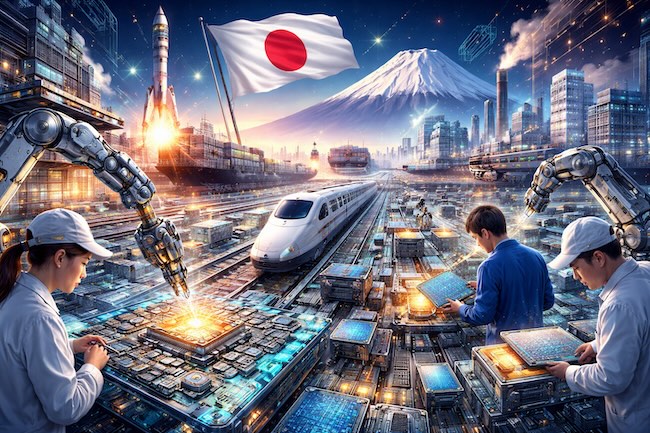
(Image by ChatGPT)
Walking through the neon-soaked streets of Akihabara or the sterile, quiet halls of a Kyoto research lab, you might get the feeling that Japan’s "tech power" status is a legacy title—something earned in the 1980s that’s being coasted on today. After all, the headlines haven't been kind for a couple of decades. We’ve watched Samsung and LG eat Sony and Panasonic’s lunch in the television market. We’ve seen TSMC become the world’s foundry while Japan’s giants struggled to keep up with sub-5nm logic chips. Even in the automotive world, the rise of Tesla and BYD has made Toyota’s cautious approach to EVs look, to some, like a stumble.
But if you think Japan is out of the game, you're looking at the wrong scoreboard. Japan hasn't exited the tech race; it’s just moved to the parts of the track where the spectators don't usually sit. While China and Korea dominate the finished goods—the shiny smartphones and the massive container ships—Japan has pivoted to dominate the "chokepoints." They’ve mastered the materials, the precision machinery, and the specialized components that the rest of the world literally cannot function without.
The Invisible Monopoly: Materials and Chemistry
If you want to understand why Japan is still a superpower, don't look at the logo on your phone; look at what’s inside the screen and the processor. The semiconductor industry provides the clearest example of Japan’s "hidden" dominance. While Japan might not lead in designing the world’s fastest CPUs anymore, they own the kitchen and the ingredients.
Take photoresists, for example. These are light-sensitive chemicals used to etch circuit patterns onto silicon wafers. Japan controls about 90% of the high-end photoresist market. In 2019, when Japan restricted the export of just three specific chemicals to South Korea due to a trade dispute, the entire Korean tech sector—including giants like Samsung—went into a localized state of panic. It was a stark reminder: you can have the world’s most advanced fabrication plant, but if Japan doesn't sell you the "magic" chemicals, you’re just left with a very expensive, very quiet room.
This dominance extends to silicon wafers (where Shin-Etsu and SUMCO hold a massive global share) and specialized components like image sensors. Sony might have lost the smartphone war, but they won the camera war; almost every high-end smartphone on the planet, including the iPhone, relies on Sony’s CMOS image sensors to take photos. Japan has realized that it’s often more profitable, and strategically safer, to be the person selling the picks and shovels than the person mining for gold.
The Precision Advantage: Robotics and Machine Tools
There’s a common narrative that Japan lost its lead in robotics to China or the US Startups in Boston or Shenzhen are making headlines with bipedal robots that do backflips, but in the world of industrial robotics—the machines that actually build the world—Japan is still the undisputed king.
Companies like Fanuc, Yaskawa, and Kawasaki are the backbone of global manufacturing. Fanuc’s yellow robots are everywhere, from Tesla’s gigafactories to pharmaceutical packaging lines in Germany. What keeps these companies ahead isn't just "tech" in the sense of software; it’s "monozukuri," the Japanese philosophy of craftsmanship. It’s the ability to create joints, gears, and sensors that can operate with micrometer precision for 24 hours a day, seven days a week, for decades without failing.
This precision extends to machine tools. If you’re building a jet engine or a high-performance medical device, you’re likely using a Japanese CNC machine from a company like DMG Mori or Yamazaki Mazak. This "upstream" tech is much harder to disrupt than "downstream" consumer electronics. You can iterate a smartphone design in six months, but you can't replicate forty years of metallurgy and mechanical engineering expertise overnight.
The Hydrogen Gamble and Energy Transition
Japan’s tech future is currently being bet on a massive shift toward the "Hydrogen Society." While much of the West has pivoted hard toward Battery Electric Vehicles (BEVs), Japan—led by Toyota and the government—has poured billions into hydrogen fuel cell technology.
Critics argue that Japan is doubling down on the wrong horse, but the Japanese perspective is broader than just passenger cars. They’re looking at heavy shipping, long-haul trucking, and steel manufacturing—sectors where batteries are currently too heavy or inefficient. Japan holds the most patents in the world related to hydrogen fuel cells and storage. If the world eventually realizes that lithium-ion batteries can’t solve every green energy problem, Japan will be the one holding the keys to the alternative.
This long-term thinking is a hallmark of Japanese tech strategy. They aren't interested in the "fail fast" culture of Silicon Valley. They prefer "succeed slowly and permanently."
The Challenges: Software and Startups
It wouldn't be honest to talk about Japan's power without mentioning where the armor is thin. Japan’s biggest weakness remains software and digital transformation. The "Galapagos Syndrome"—a term used to describe products that evolve in isolation for the Japanese market—still haunts the country. Japan’s domestic software market is often clunky, and the country has been slow to adopt cloud computing and AI at the same pace as the US or China.
The corporate culture, while great for perfecting a mechanical gear, can be stifling for a software developer. The traditional "seniority-based" pay scales and the risk-averse nature of venture capital in Tokyo mean that Japan hasn't produced a Google or a Meta. However, even this is changing. The government has recently launched initiatives to bridge the "startup gap," and there’s a growing realization that "hard tech" needs "soft tech" to survive in the 2020s.
Why It Matters for the Rest of Us
So, why should we care that Japan keeps its tech power? Because Japan is the "stabilizer" in the global supply chain. In an era of geopolitical tension between the US and China, Japan sits as a technologically sophisticated, reliable partner that values intellectual property and international standards.
When a disaster hits Japan—like the 2011 earthquake—the global automotive and electronics industries grind to a halt. That’s not because we miss their finished products; it’s because we miss their tiny, specialized resistors, their high-purity resins, and their precision lenses.
Japan has transitioned from being the world’s department store to being the world’s most exclusive laboratory and machine shop. They’ve moved into the "foundational" layers of technology. You might not see their name on the box as often as you did in 1992, but if you take that box apart, you’ll find Japan’s fingerprints on almost every piece of high-value silicon and steel inside.
The Resilience of Monozukuri
At the end of the day, what keeps Japan a tech power isn't a single invention or a specific company. It’s a culture of incremental, obsessive improvement. In the West, we love the "disruptive" hero—the college dropout who changes the world with an app. In Japan, the hero is the engineer who spends thirty years perfecting the coating on a single lens so that it reflects 0.01% less light.
That dedication to the "boring" parts of technology is exactly what makes Japan un-disruptable. You can disrupt a social media platform with a better algorithm. You can’t easily disrupt a company that has spent half a century mastering the molecular structure of high-grade carbon fiber.
Japan’s tech power is now structural. It’s baked into the very way we build things in the 21st century. As we move into an era of more complex needs—quantum computing, advanced biotechnology, and deep-space exploration—the world is going to need more "hard tech." It’s going to need the materials and the precision that only Japan seems to have the patience to perfect.
The "lost decades" might have cost Japan its lead in the consumer spotlight, but they’ve used that time to entrench themselves in the guts of the global economy. Japan isn't chasing the future anymore; they're the ones building the tools that the rest of us will use to get there.
© 2026 by Asian Media Group Inc.
Recent Articles
- Global Demand Surges for Anti-Drone Technology
- BYD Looks to Formula One for Fast Global Brand Expansion
- Europe's EV Sales Keep Growing As Fuel Costs Rise, Car Prices Fall
- SK Hynix Ships Samples of Next-Generation AI HBM Chips
- Apple to Raise Prices Due to Memory Chip Shortage
- Trump Scraps Four More Offshore Wind Leases with $765 Million Refund
- Oil Roundtrips, AI Booms, US Consumers Spend, Economists' Fed Outlooks Go Wild
- Trump Endorsee Loses in Georgia Governor's Primary Race
- BMW Shares Sink After Profit Warning Highlights China and Iran Risk
- AI Will Lead to Labour Shortages, Bezos Says at Paris Conference