

Why Americans Can't Save and Chinese Can't Spend
By H Y Nahm | 27 Jun, 2026
The contrasting consumption habits keep the world's biggest economies locked in a comical but critically co-dependent relationship.
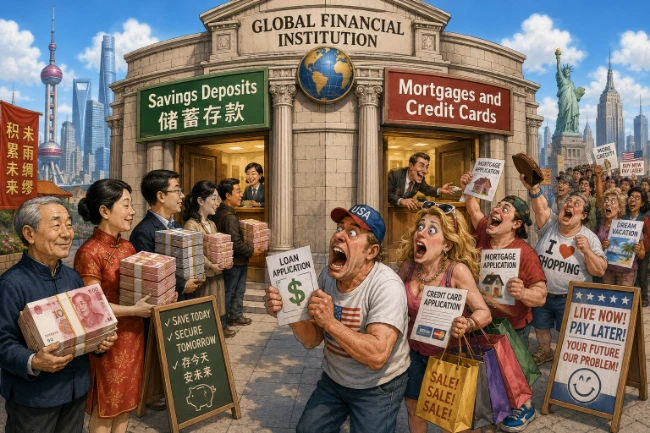
There's a wonderful joe buried in the architecture of the global economy.
The world's richest consumer society — a nation where retail therapy is practically a constitutional right — can barely scrape together a rainy-day fund. Meanwhile, the world's largest manufacturing powerhouse produces goods it increasingly struggles to sell to its own people.
One economy can't stop spending. The other can't start. And yet, like a mismatched couple who've been together so long they've forgotten what life looked like before, neither can quite function without the other.
This isn't just an amusing paradox. I t's the central structural tension of 21st-century economics, and it's reshaping trade policy, geopolitics, and the daily financial lives of ordinary people on both sides of the Pacific.
The American Spender
Let's start with the numbers, because they're genuinely striking. The US personal savings rate stood at just 3.8% at the end of 2024 — meaning Americans were putting aside less than four cents of every dollar of disposable income they earned. By early 2026, that figure had dipped further to around 2.6%. For comparison, the rate briefly surged above 30% during the pandemic lockdowns of 2020, when there was quite literally nowhere to go and nothing to spend money on. The moment restrictions lifted, Americans resumed their natural habitat: the checkout line.
This chronic low-savings condition isn't an accident or a personal failing of individual Americans. It's baked into the structure of the US economy and, arguably, into its cultural DNA. Consumer spending accounts for roughly 68% of US GDP — well above the 60% average across OECD countries. The American economy doesn't just tolerate consumption; it depends on it the way a car depends on fuel. When spending slows, the whole machine coughs and sputters.
The consequences of this arrangement are visible in the balance sheet of everyday life. According to a 2025 survey, 21% of Americans have no emergency savings at all, and nearly two in five say they couldn't cover an unexpected expense of $400. The median emergency fund sits at just $600 — roughly enough to cover a busted water heater or a visit to an urgent care clinic, but not both. Nearly half of US adults don't have sufficient savings to cover three months of expenses if they lost their income.
The paradox deepens when you consider what's happening at the macro level simultaneously. Even as households struggle to save, the US is running an overall trade deficit of nearly $900 billion — a gap that must be financed by somebody, somewhere, buying American debt. That somebody has historically included a country whose households save at a rate that would make any American financial advisor weep with joy.
The Chinese Saver
China's gross domestic savings rate was 43.1% of GDP as of 2025 — a figure that towers over virtually every major economy on earth. Chinese households, on average, save a share of their disposable income that dwarfs what their American counterparts manage. This isn't a recent phenomenon; it's been the defining feature of China's economic model for decades. Gross domestic savings surged past 50% of GDP during the 2007–2010 period and has remained extraordinarily high ever since.
The question economists have wrestled with for years is: why? Chinese households aren't saving because they're wealthier, on average, than Americans. They're saving because they're scared. The demolition of China's "iron rice bowl" — the Mao-era system of cradle-to-grave state support — left hundreds of millions of people suddenly responsible for funding their own healthcare, education, and retirement. Without robust public systems to catch them, they responded the only way rational people can: by hoarding cash.
The data backs this up. Economists at the Brookings Institution found that the motive of saving for healthcare expenditures alone can account for more than five percentage points of increase in China's household saving rate. Add in education costs and the near-total absence of the kind of social safety net that European nations take for granted, and the picture becomes clear. Chinese households aren't savers by nature. They're savers by necessity.
The result is that private consumption in China accounts for only about 40% of GDP — the lowest share among any major economy, and roughly 28 percentage points below the US figure. Chinese consumers aren't buying enough stuff, not because they don't want things, but because the precautionary logic of their situation tells them to hold back. Consumer confidence has collapsed in recent years. Retail sales growth reached only 3.7% in 2024 — roughly 1 percentage point of GDP growth — even as the government has been desperately trying to coax its citizens into opening their wallets.
The Trade Arithmetic
Here's where the two dysfunctions become each other's problem — and each other's solution.
When Americans spend more than they produce, they import the difference. When Chinese producers make more than their citizens can absorb, they export the surplus. The arithmetic is almost too clean: US demand meets Chinese supply, and what falls out of the equation is a trade deficit that has been a permanent feature of the bilateral relationship for decades.
In 2024, the US ran a $295 billion goods deficit with China, partially offset by a $32 billion services surplus, leaving a net bilateral gap of $264 billion. This made China the single largest source of America's trade imbalance — a distinction it's held for years, even as its share of the overall US goods deficit has declined from 47.5% in 2018 to 24.6% in 2024 as tariffs have redirected some trade flows through Vietnam, Mexico, and other third countries. Don't be fooled by that shift: the goods are often still made in China, just relabeled and re-routed.
China's overall trade surplus, meanwhile, hit a record $1.19 trillion in 2025 — a 20% increase from the previous year. That's not a trade surplus. That's an industrial strategy. And it's financed in part by Chinese households who keep saving instead of buying.
The Capital Flow Loop
The money doesn't just sit there. Here's the part of the story that most trade warriors conveniently ignore: the same imbalance that produces the trade deficit also produces a capital flow that helps keep the US economy running.
When China exports goods to the US, it accumulates dollars. Those dollars don't stay in yuan — China recycles them back into US financial markets, primarily by purchasing US Treasury bonds. As of December 2024, China held $759 billion in US Treasuries, making it the second-largest foreign creditor of the US government. Even as it's been gradually reducing those holdings — down to approximately $756 billion by May 2025, the lowest level since 2009 — the stock remains enormous.
This recycling mechanism is what economists call the "savings glut" dynamic, a concept former Federal Reserve chair Ben Bernanke famously articulated. Chinese savings flow into US capital markets, keeping interest rates lower than they'd otherwise be, which in turn makes it cheaper for American households and the federal government to borrow and spend. In other words, China's inability to consume its own output doesn't just produce cheap iPhones and sneakers for American consumers. It also helps finance the American mortgage market.
The US current account deficit widened to 3.9% of GDP through December 2024 — a persistent structural gap that reflects the fundamental mismatch between what Americans produce and what they consume. That gap requires constant foreign financing. China, whether it intends to or not, has long been one of the primary providers of that financing.
Why Neither Side Can Easily Change
Both governments understand this dynamic and have been "rebalancing" their economies for roughly two decades, with limited success.
China has made boosting domestic consumption an explicit priority since at least 2004. The results have been frustratingly modest. Consumer spending's share of GDP has risen from its nadir of around 35% in the early 2010s to roughly 40% by 2024 — progress, but still far below the levels seen in peer economies. The problem is structural: you can't get people to spend more when they're terrified of a medical bill wiping out their life savings. Until China builds the kind of social safety net that makes precautionary saving less essential, its households will keep hoarding.
America's problem is the mirror image. US households are not, by and large, making a free choice to undersave. They're operating in an economy where wages have stagnated for large portions of the workforce, housing costs consume an ever-larger share of income, and credit is both cheap and aggressively marketed. The financial industry has spent decades making it easier to borrow than to save. The incentive structure points relentlessly toward consumption.
Tariffs — the preferred policy tool of the current moment — don't fix any of this. They can redirect trade flows and create short-term pain for exporters, but they don't address why Americans don't save or why Chinese citizens can't spend. If anything, tariffs risk making both problems worse by raising prices for American consumers, reducing their already-thin purchasing power, and creating enough economic uncertainty that Chinese households save even more as a precaution.
The Codependency Runs Deep
What makes this relationship so fascinating — and so difficult to unwind — is that both sides have genuinely benefited from the arrangement, even as it's created genuine harms.
American consumers have enjoyed decades of access to inexpensive manufactured goods that their own wages couldn't have purchased if those goods were made domestically. Chinese exporters built the world's largest manufacturing base and lifted hundreds of millions of people out of poverty in the process. American financial markets received a reliable buyer of Treasury debt that helped keep borrowing costs manageable. Chinese foreign reserves accumulated a vast stock of safe assets.
The harms are equally real. American manufacturing communities hollowed out. Chinese households built lives of precautionary anxiety. Both countries became dependent on the other in ways that neither fully controlled or felt comfortable acknowledging.
What's emerging now — through tariffs, export controls, industrial policy, and the gradual reshoring of supply chains — isn't a clean breakup. It's more like a separation with shared custody of the global economy. The savings gap that created this relationship won't disappear because politicians on both sides have decided it's inconvenient. The American consumer will keep spending. The Chinese household will keep saving. And economists will keep writing papers explaining why both need to stop doing exactly what their circumstances are telling them to do.
The comically codependent relationship between these two economies isn't a bug. For a very long time, it was the feature.
Data sources: US Bureau of Economic Analysis; CEIC; Council on Foreign Relations; US Treasury Department; Peterson Institute for International Economics; Rhodium Group; Brookings Institution.
© 2026 by Asian Media Group Inc.
Recent Articles
- Both Japan and Sweden Advance with Draw
- S. Korea to Train 500,000 'Drone Warriors' to Counter North
- Why Americans Can't Save and Chinese Can't Spend
- Samsung to Invest $648 Billion, Mostly Outside Seoul Region
- Sanjay Mehrotra's Micron Overtakes Meta, Tesla in Market Value
- Lackluster S. Korea Suffers Embarrassing 0-1 Loss to S. Africa
- China's Carmakers See Canada as 'Practice Run’ for US Sales
- China's Z.ai Closes Frontier Gap with US AI Leaders
- China Targets Solar, Wind Power Producing Half of Electricity by 2030
- US Automotive Quality Increased Industrywide Last Year