

Tony Xu's Surprising White House Delivery
By J. J. Ghosh | 17 Apr, 2026
Eyebrows were raised when CEO Tony Xu let Doordash participate in a pro-Trump media event.
President Trump had a McDonald’s order delivered to the Oval Office on Tuesday.
Well… sort of. It was a publicity stunt meant to highlight the President’s “no tax on tips” policy.
And as far as the White House is concerned, it was in theory not a bad idea. Had, say, Obama done this, we probably would have gushed over how charming and funny the 44th President was, not to mention that it’s a policy that appeals to working class Americans.
But of course that’s not how this one played out.
Not only did Trump quickly derail the topic by asking the “DoorDash” employee about her view on men playing in women’s sports, but it quickly surfaced that the so-called delivery woman — wearing a “DoorDash Grandma” shirt — was actually a Trump supporter who had previously championed his policies during a Capitol Hill testimony.
DoorDash’s head of public affairs had helped engineer the stunt. When it unraveled, his social media response — defending the bungled PR attempt publicly — made him the story instead of the policy.
Overall, it felt like an oddly partisan move on the part of DoorDash. I couldn’t help but wonder why such a successful business would choose to tie themselves at this particular moment to a president with historically low approval ratings.
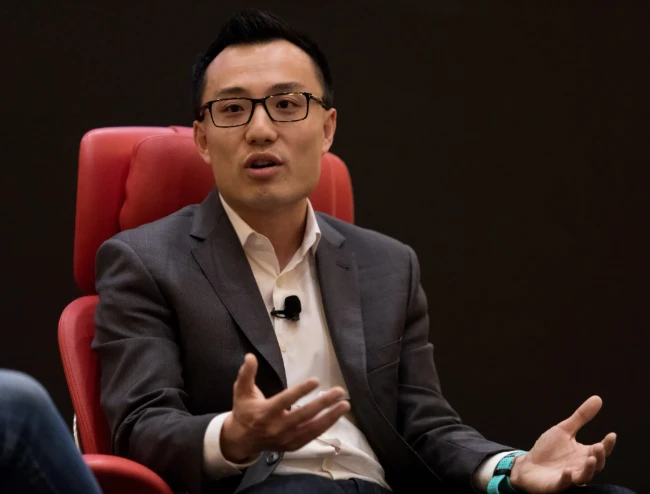
So I decided to learn more about the man who runs DoorDash: Tony Xu.
The American Dream, Delivered
Tony Xu was born in Nanjing, China in 1983 or 1984 and immigrated to the United States with his parents at the age of four, settling in Champaign, Illinois. His mother, Julie Cao, was a doctor in China who later opened acupuncture and medical clinics.
It’s the kind of immigrant origin story that usually gets celebrated in American political discourse — at least when it’s convenient. Xu has said the experience of watching his mother work in a Chinese restaurant, and his own time as a dishwasher there, planted the seed for what eventually became DoorDash.
In 2013 while attending Stanford University, Xu and classmates co-founded DoorDash. By April 2022, it had become the United States’ largest food delivery service. Xu took the company public in December 2020, which made him a billionaire.
They didn’t launch the company with venture capital and a fully formed product. They started by doing the deliveries themselves. In the early days, Xu and his co-founders were the ones driving around Palo Alto with takeout bags in their cars, personally fulfilling orders through a website they had built in a few hours to test whether anyone even wanted the service. The answer, apparently, was yes.
Before Stanford, Xu had put in time at McKinsey, eBay, and PayPal — a resume that reads like a checklist of institutions designed to produce exactly the kind of person who founds a billion-dollar company. He had also interned at Square, Jack Dorsey’s payments startup, which gave him an early window into how technology could reshape the way small businesses operate. That insight became foundational to how DoorDash positioned itself — not just as a delivery service, but as infrastructure for local economies.
What makes Xu’s control over the company particularly notable is the share structure he put in place when DoorDash went public in 2020. While Xu owns roughly 5% of the company’s total equity, he controls approximately 69% of the voting interest through a dual-class share structure that concentrates decision-making power in his hands. In other words: DoorDash’s investors own most of the company, but Tony Xu runs it. Whatever the company does politically — including staging Oval Office photo opportunities — is ultimately his call.
Which is worth keeping in mind when assessing who bears responsibility for the DoorDash Grandma.
Political History
Tony Xu is not apolitical. He has, in fact, been quite politically active — just not in the direction Monday’s spectacle would suggest.
Xu has been a significant donor to Democratic politicians and causes, giving money to Gavin Newsom, Joe Biden, and Pete Buttigieg.
In 2021 he was one of the major supporters of the Stand With Asian Americans campaign, which donated $10 million to mostly left-leaning Asian American organizations to oppose hate crimes against Asian Americans.
So why is a Democratic-leaning Chinese American tech billionaire staging photo opportunities for Donald Trump?
It had to be motivated solely by business.
DoorDash spent $2.38 million on federal lobbying in 2025 alone. The company has a registered PAC and a team of public affairs executives whose entire job is to keep Washington friendly.
Perhaps when the “no tax on tips” policy is on the table and the White House calls, a company that employs hundreds of thousands of gig workers has a very clear financial incentive to show up with a smile and a bag of McNuggets, regardless of who’s sitting behind the Resolute Desk.
It’s also worth noting that in 2026, Xu contributed $2 million to a California political action committee opposing a proposed wealth tax on billionaires. That particular donation cuts across party lines in a revealing way: when his own fortune is directly at stake, Xu’s politics get considerably more flexible.
A Questionable Calculation
To be clear: while I have no shortage of qualms with President Trump, my issues here are not simply with Xu’s willingness to work with him.
While Xu’s politics may not align exactly with mine — though based on his donation history, we may not be far off — I understand the realities of what it takes to run a successful business. I might be personally disappointed to see Xu attempting to hand a PR win to a man whose time in office can best be described as making life crueler for people who look like Xu’s own mother.
When CEOs like Jeff Bezos cozied up to the President following his election, I at least understood it: the majority of the electorate had voted for Trump for the first time in his three presidential campaigns. His popularity and political capital were at an all-time high.
Eighteen months later, that calculation looks considerably less sound.
Trump’s approval rating has fallen to historic lows — lower, by most measures, than any president in the modern polling era at this stage of their presidency. The tariff chaos has rattled financial markets and alienated the business community that was supposed to be his natural constituency. The Medicaid cuts have put Republican senators in states Trump won on defense. The enthusiasm that characterized the early days of the second term has curdled into something closer to exhaustion, even among his supporters.
What I don’t understand is Xu’s willingness to jump aboard a rapidly sinking ship in 2026.
The companies that made the Bezos bet in late 2024 were at least buying goodwill at market rate. What DoorDash appears to have bought in April 2026 is a PR crisis, a meme, and a head of public affairs who spent 48 hours arguing with strangers on the internet. The political capital they were presumably hoping to bank with this White House is depreciating faster than they can spend it.
Assuming that this was in fact a business play, I simply don’t see the vision. But then again, he started a billion dollar company and I didn’t.
© 2026 by Asian Media Group Inc.
DoorDash’s investors own most of the company, but Tony Xu runs it. Whatever the company does politically — including staging Oval Office photo opportunities — is ultimately his call.
Recent Articles
- Global Demand Surges for Anti-Drone Technology
- BYD Looks to Formula One for Fast Global Brand Expansion
- Europe's EV Sales Keep Growing As Fuel Costs Rise, Car Prices Fall
- SK Hynix Ships Samples of Next-Generation AI HBM Chips
- Apple to Raise Prices Due to Memory Chip Shortage
- Trump Scraps Four More Offshore Wind Leases with $765 Million Refund
- Oil Roundtrips, AI Booms, US Consumers Spend, Economists' Fed Outlooks Go Wild
- Trump Endorsee Loses in Georgia Governor's Primary Race
- BMW Shares Sink After Profit Warning Highlights China and Iran Risk
- AI Will Lead to Labour Shortages, Bezos Says at Paris Conference