

90s Anime vs Classic Literature
By Victor Wong | 04 Jul, 2026
I'd like to make a case that some classic anime has as much literary value as some of the classics.
Victor (00:00)
After almost a decade of graduating from school, I have decided to read again, particularly classics. Most recently I have picked up the works of Franz Kafka, and as I find myself sifting through it, I've noticed a certain level of discomfort when it comes to reading.
Victor (00:29)
I mean, this discomfort comes as no surprise given how much stimulation my brain has become accustomed to with the advent of streaming services and short form content via YouTube and Instagram. Reading by comparison is just not as stimulating. And I find myself contending with this discomfort every time.
I open my book.
Victor (01:04)
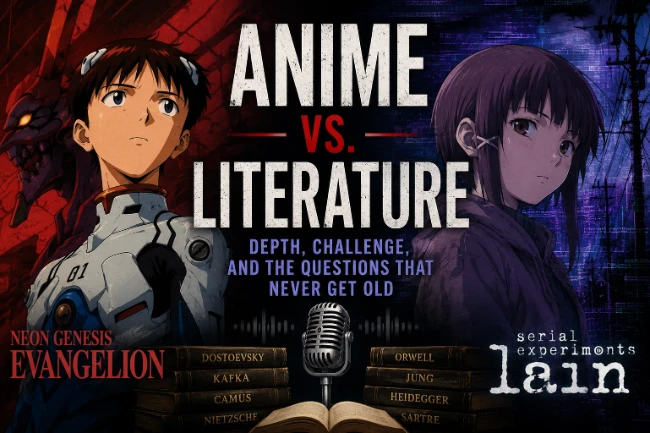
As I sat down with my discomfort at this slow rate of consumption, I started to recognize this sensation. It's actually very similar to the feeling I get when watching old classic anime from the 90s, such as Neon Genesis Evangelion, Cowboy Bebop, and Serial Experiments Lane. I know as animated
Works, people oftentimes assume that these are pieces of media designed for children, but in reality, a lot of classic anime has a level of discomfort built into it similar to reading classic literature.
Victor (01:57)
Of course, in an anime, there are moving pictures, right? You don't have to take the same amount of mental work to create a picture in your mind from reading the words on the page. But what I found about these classics is they weren't afraid of forcing the viewer to linger on an image. A lot of times in classic work, such as Neon Genesis Evangelion.
You would spend 30, 15, sometimes 20 seconds just lingering on one frame, forcing the audience to contend with a much slower pace and to really sit with the atmosphere of the anime and to immerse themselves into the character's thoughts.
Victor (02:48)
Yes, I do have to acknowledge that the use of stills was often done out of necessity as animating moving images is an expensive process and there was not a lot of money going into these anime studios at the time. However, I think studios like Gynax did a very good job at using still images to enhance the themes and the messages that they were trying to convey.
Victor (03:19)
As an elder Weaboo, I have witnessed anime start as a low-budget, niche form of entertainment and grow into a multi-billion dollar industry. Every year I'm constantly impressed by what studios are able to produce. And that's a great thing. But with the increased emphasis on spectacle, I can't help but feel that a lot of modern anime
Is losing the narrative depth that old classics had.
Victor (03:56)
One hallmark of classic literature is that it refuses to give us simple answers. Take Dostoevsky's the brothers Karamasov. Every major character represents a competing philosophy of human existence. Ivan wrestles with rationalism and the problem of evil. Alyosha represents faith and compassion, and Dmitri embodies passion and impulse. None of these characters are caricatures, and Dostoyevsky never
Simply declares one worldview victorious. Instead, he creates tension between them and asks the reader to wrestle with those ideas personally. Neon Genesis Evangelion operates in almost the same way. At its surface, Neon Genesis Evangelion is about teenagers piloting giant robots to fight aliens.
But that is merely set dressing for a story that deals with the ways each character grapples with their need for intimacy. Every major character is trapped by a different wound. Shinji desperately wants acceptance, yet constantly retreats from intimacy out of a fear of rejection. Asuka builds an identity entirely upon achievement because she believes failure makes her unworthy of love. Gendo
grieving the loss of his wife, sacrifices every relationship in pursuit of control over loss, even going as far as to alienate his son.
Victor (05:33)
As the series progresses, each character must grapple with how they have chosen to handle their pain and suffer as a result, all while having to fight against the eldritch horrors referred to as angels. Ano isn't asking whether humanity can defeat monsters. He's asking whether people can ever truly know and understand each other. This idea becomes even clearer through what psychologist Carl Jung calls the shadow. Jung argued that every person hides parts of themselves they cannot accept.
Those rejected aspects do not disappear. Instead, they quietly influence behavior from the unconscious. Evangellian constantly visualizes this process. Characters aren't fighting angels nearly as much as they're confronting the parts of themselves they've spent years suppressing. By the final episodes, the battlefield shifts from a physical one against the angels to a psychological one. In fact, the battlefield has become consciousness itself, as the barriers separating the consciousness of all the characters dissolve.
melding the minds of humanity into a primordial soup.
Victor (06:38)
Most narratives build toward external resolution. The hero defeats the villain and everyone lives happily ever after. However, Evangelion intentionally dismantles that expectation. Instead of climaxing with explosions, it climaxes with introspection. Though, if we're being honest, Studio Gynax ran into budget issues, which forced them to settle on a more subdued ending originally.
Gynax eventually did release the quote unquote true final episodes titled The End of Evangelion Part 1 and Part 2, which managed to send the series off with a bang. They combined brutal action with an uncomfortable reflection on the fan base's desires, which I won't go into further detail to keep this podcast advertiser friendly. I will say it poetically traps Shinji in his personal hell as he is left alone as one of two surviving humans on devastated planet Earth with someone who actually
Absolutely despises him. Apologies for the spoiler.
The original ending frustrates many viewers because it refuses to satisfy the desire for neat conclusions and double digit frame rates. I still believe the original ending has artistic value despite its flaws. As the viewer is running hot from the action leading up to the finale, they are abruptly forced to contend with Shinji's pain as he has difficult conversations with each character in the show. Classic literature often behaves in exactly the same way. Kafka rarely explains.
Evangelion belongs comfortably in that tradition. It doesn't want the viewer to understand everything.
I do have to acknowledge the budgetary constraints experienced by Gynax that forced them to take a lot of shortcuts. Ava was forced to use stills and ambient noise for many scenes. However, I believe that the use of stills was an integral part of what makes Ava special. The 15 to 20 seconds of Shinji riding in train cars forces the viewer to sit in the uncomfortable silence and reflect on the weight of each traumatic event Shinji had to face. Modern life provides us many distractions from our own thoughts, while
Ava has a way of forcing the viewer to confront them.
Victor (08:51)
Even the famous Hedgehog's Dilemma, borrowed from philosopher Arthur Schopenhauer, demonstrates how deeply Evan Gellien draws from philosophical traditions. Schopenhauer imagined hedgehogs huddling together during winter. If they stay too far apart, they freeze. If they move too close, they wound each other with their spines. Humans, Evan Gellien suggests, face the exact same paradox. We need intimacy, but intimacy inevitably risks pain.
Almost every relationship in the series reflects this single philosophical idea. Shinji avoids closeness because rejection terrifies him. Asuka demands validation while pushing everyone away. Gendo chooses isolation entirely, but in his grief precipitates the end of humanity.
The giant robots and eldritch whores become secondary. The real story asks whether imperfect people can ever truly connect.
Victor (09:54)
If Evangellian explores psychology, serial experiments Lane explores ontology, the branch of philosophy that asks perhaps the oldest question imaginable. What is real? This is where Lane shows how ahead of its time it was. It reminds me of a quote: The map is not the territory, the menu is not the meal. While this may have been true just 10 years ago, the internet has distorted reality. Turning the map into the territory is
And the menu into the meal. Since its premiere in 1998, Lane has anticipated nearly every philosophical debate surrounding digital identity, well before the rise of smartphones and social media. Lane refers to the internet as the wired, a place where memory, identity, information, and existence begin dissolving into one another, just as social media takes our data and our memories and displays it for all to see.
Lane poses questions such as if every memory of you disappeared, would you still exist? If your personality could be copied perfectly, which version would be you? If everyone believed a different history about your life, which history becomes reality?
Victor (11:13)
Again, through the internet, the menu is now the meal and the map is now the territory.
Victor (11:20)
perception has become a reality in and of itself.
Victor (11:24)
These aren't computer science questions. They're metaphysical questions. Kafka feels like an obvious literary comparison. His protagonists constantly discover that reality obeys rules they cannot understand. Nothing feels stable, authority is invisible. Meaning slips away just as it's about to become clear. Watching Lane produces a remarkably similar feeling. Episodes often end without resolution. Characters contradict themselves.
Reality quietly shifts, memories change, people appear where they shouldn't.
Victor (12:02)
Instead of providing certainty, every answer generates more questions. The audience slowly experiences the same confusion as Lane herself. Rather than explaining philosophical uncertainty, the series makes viewers inhabit it. One of Lane's most fascinating ideas concerns identity as performance. Today we all maintain multiple versions of ourselves. Professional profiles, private messages, anonymous accounts, public personas, family versions.
Friend versions. Different people know a different you. Lane predicted this fragmentation decades before social media normalized it. Throughout the series, different characters encounter different versions of Lane. Some remember conversations that never occurred. Others insist they meant a completely different lane. Which one is real? The uncomfortable answer may be all of them or none of them. Identity becomes less like a fixed object and more like an ongoing negotiation between
Memory, perception, and relationship.
Victor (13:06)
The show's visual language reinforces this uncertainty. Notice how often electrical wires dominate the frame. Power lines stretch endlessly across empty skies. Most viewers would treat them as scenery, but they're anything but. They symbolize invisible connection, signals constantly passing between people who remain emotionally isolated. They're reminders that communication does not guarantee understanding. Ironically, the more connected society becomes,
The lonelier many individuals appear. Again, this was made in 1998. Before Facebook, before Instagram, before smartphones, before algorithms shaped daily life. That is why Lane feels prophetic rather than dated. It wasn't predicting technology, it was predicting human behavior. Perhaps the greatest compliment you can pay either Evan Gellion or Lane is the same compliment often given to classic literature. They improve with rereading.
The first viewing asks, what happened? The second viewing asks, what did it mean? The third viewing asks something entirely different. What does this say about me? That's exactly what happens when people revisit Dostoevsky, Kafka, Camus, or Shakespeare. The text remains unchanged. The audience changes. And because the audience changes, the work reveals something new every time. That is one of the defining characteristics of a true classic.
Whether it's printed on paper or animated on a screen becomes almost irrelevant. What matters is whether the work continues to challenge us decades after its creation. And in that respect, Neon Genesis Evangelion and Cyril Experiments Lane have earned their place alongside some of the greatest works of modern philosophical storytelling.
© 2026 by Asian Media Group Inc.
Recent Articles
- Trump Marks Nation's 250th Birthday with Campaign-Style Speech on National Mall
- Keiko Fujimori Declared Winner of Peru Presidential Race
- Mass Grief at Khamenei Funeral Suggests Hardline Grip Continues
- AI Turbocharged a Startup, Restructures the Economy
- US-EU Trade Hits Record High Despite Tariff Tensions, Study Shows
- Chinese Independent Refiners Snap up Discounted Mideast Oil as Supplies Rise
- US Oil Companies See Big Profit Jump, Faces Pressure to Cut Pump Prices
- Drug Gangs Use Social Media to Recruit Thai Air Crew as Couriers
- Ghonhee Lee's Katalyst Launches Orbital Rescue Mission for NASA Satellite
- 90s Anime vs Classic Literature