

Bedtime Story: Tale of Jangwha and Hongryeon
By Dreaming Engine | 30 Jun, 2026
This Korean folk tale features a pair of devoted sisters slandered by a wicked stepmother finding peace and vindication only after their death.
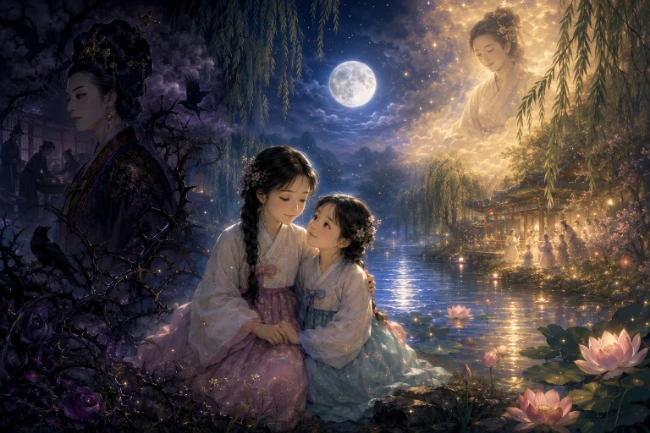
Come close, my little dumplings. Tuck your toes under the blanket, pull the moonlight up to your chin, and listen to an old story from long ago, when villages were quiet after sunset and even the crickets seemed to whisper politely.
Once there lived two sisters named Janghwa and Hongryeon.
Janghwa, the older sister, had a heart like a spring morning. She was gentle, patient and always thinking of others. Hongryeon, the younger sister, was bright as a little red flower after rain. She laughed easily, asked too many questions and could never keep her hair ribbon tied for more than five minutes.
“Grandmother,” you may ask, “why are little sisters always losing their hair ribbons?”
Ai-goo, because little sisters are part child, part breeze. That is simply how the world was made.
The girls lived with their father, a scholar named Bae, in a house with a tiled roof, a persimmon tree in the yard and a pond beyond the garden wall. When their mother was alive, the house was filled with warmth. She would brush Janghwa’s hair, braid Hongryeon’s, and say, “My two blossoms, look after each other. A sister is a lantern when the road grows dark.”
But when the girls were still young, their dear mother became ill and went away to the place where good mothers rest among the stars.
For a long while the house felt hollow. Their father walked softly, as if loud footsteps might break what little peace remained. Janghwa tried to help with the cooking. Hongryeon tried to help too, though once she put salt into the tea instead of sugar, and everyone made such faces that even the sad house nearly laughed.
After some time, their father married again. His new wife came into the home wearing fine clothes and a sharp smile.
Now, children, not every stepmother in a story is unkind. Some are warm as fresh rice. Some are sweet as roasted chestnuts. But this one — ah, this one had a heart that had grown narrow from jealousy. When she saw how beautiful and beloved Janghwa and Hongryeon were, her thoughts turned sour.
She had sons of her own, and she wanted all the family’s love, all the family’s fortune and all the family’s good luck to belong only to them.
So she began with little cruelties.
If Janghwa sewed a neat seam, the stepmother sniffed and said, “Crooked.”
If Hongryeon swept the floor, the stepmother pointed to one speck of dust and said, “Lazy.”
If the sisters ate a bowl of rice, she said they were greedy. If they ate less, she said they were ungrateful. A person who wants to be cruel can always find a reason, even if she must invent one out of thin air and old cabbage leaves.
But the sisters did not answer harshness with harshness.
At night, they sat together by the small lamp.
“Unni,” Hongryeon whispered to Janghwa, “will it always be this way?”
Janghwa took her sister’s hand. “No season lasts forever. Even winter gets tired and lets spring come in.”
So they endured. They remembered their mother’s words. A sister is a lantern when the road grows dark.
But the stepmother’s jealousy grew bigger, and one day she told a terrible lie about Janghwa. It was such an ugly lie that I will not place it fully in your ears before bedtime. Let us only say that she tried to make Janghwa’s father believe his daughter had brought shame upon the house.
Poor Scholar Bae was weak in spirit. Instead of looking into his daughter’s clear eyes and asking for the truth, he believed what his wife told him. That is a sad thing, children. Sometimes grown-ups, even fathers, can be foolish when they are frightened or tired or too eager for peace.
Janghwa was sent away from the house, weeping so quietly that even the wind felt ashamed to blow. She walked to the pond beyond the garden, where reeds bent their heads and dragonflies skimmed the water.
There, in that lonely place, the poor girl disappeared from the world of the living.
When Hongryeon learned what had happened, her little heart cracked like thin ice.
“My sister was innocent,” she cried. “My Janghwa would never do wrong.”
But no one listened. The stepmother turned her face away. The father covered his eyes with sorrow and confusion. Hongryeon went to the pond and called her sister’s name again and again.
“Janghwa! Janghwa! Your little sister is here!”
The pond answered only with ripples.
Soon after, Hongryeon too vanished from the house. Some say she followed her sister out of grief. Some say her heart simply could not stay in a world where truth had been buried so deeply.
Now, do not be frightened, my little ones. The sisters did not become monsters. They did not become shadows with sharp teeth or dreadful things that hide under beds. No, no. Pull that blanket back down. I see your knees hiding.
They became spirits of sorrow — pale, gentle and quiet — wearing white robes like moonlight on snow. They did not want revenge. They wanted only one thing.
They wanted the truth to be known.
After that, strange things began to happen in the village. Whenever a new magistrate came to govern the district, he heard soft crying near the pond at night. Then he saw two young girls standing beneath the willow trees, their faces sad but kind.
“Please,” they whispered, “listen to us.”
But the magistrates were proud men, and proud men often have very poor ears. Instead of listening, they became frightened and ran away. One even hid behind his own hat, which, as you know, is not a very useful fortress.
At last, a brave new magistrate arrived. His name was Won, and he was not only brave but sensible, which is much better. Bravery without sense is just a rooster fighting a cooking pot.
On his first night in the village, Magistrate Won sat awake in his office. The lamp flickered. The bamboo outside tapped against the window. Tap, tap, tap.
Then came the sound of weeping.
Not loud. Not angry. Just sad enough to make the candle flame tremble.
The doors opened by themselves, and in stepped Janghwa and Hongryeon, dressed in white, their hands folded politely before them.
Magistrate Won’s guards yelped and hid behind each other. One dropped his spear. Another tried to bow and run at the same time, which is difficult and not graceful.
But the magistrate stayed seated.
“Young ladies,” he said gently, “you have come a long way through sorrow. Tell me what happened.”
At last — at last! — someone listened.
Janghwa told him about the stepmother’s jealousy. Hongryeon told him about the lie. Together they told him where the truth could be found and how their innocence could be proven.
Magistrate Won listened to every word. He did not interrupt. He did not scold. He did not say, “That cannot be,” simply because it was hard to hear.
The next morning, he called the household together. The stepmother arrived wearing her sharp smile, but her hands trembled like leaves.
The magistrate asked questions. Then more questions. Then one very quiet question that made the stepmother’s face turn pale.
Lie by lie, her story came apart, like a straw sandal in the rain.
At last, the truth stood in the room where everyone could see it.
Janghwa had been innocent. Hongryeon had been faithful. The sisters had been wronged by jealousy and by those who failed to protect them.
Scholar Bae fell to the floor and wept.
“My daughters,” he cried, “my poor blossoms. I should have trusted you. I should have listened.”
And that, children, is one of the heaviest sorrows in the world — to understand too late what love should have understood at once.
The wicked stepmother was punished according to the laws of those old days, and her lies could harm no one anymore. The village finally breathed freely again. The pond became peaceful. The willow trees no longer shook with midnight crying.
That night, Magistrate Won dreamed of the two sisters.
They stood beneath a sky full of stars. Janghwa smiled with the calm of a flower opening at dawn. Hongryeon’s ribbon was tied properly for once, though I suspect heaven helped.
“Thank you,” they said. “Now our names are clean. Now our hearts can rest.”
Then they turned and walked together along a silver road of moonlight, hand in hand, until they disappeared among the stars where their mother waited.
From that day on, the people of the village remembered Janghwa and Hongryeon not as sad ghosts, but as two devoted sisters whose love stayed bright even in darkness.
And so, my little ones, what does this old tale teach us?
It teaches us that jealousy is a worm that eats the heart from the inside.
It teaches us that lies may run fast, but truth walks steadily and arrives in the end.
It teaches us that when someone is hurting, the bravest thing we can do is listen.
Most of all, it teaches us what the girls’ mother told them long ago:
A sister, a brother, a cousin, a friend — anyone who loves you truly — can be a lantern when the road grows dark.
Now close your eyes, my little blossoms. The pond is quiet. The willow trees are still. Janghwa and Hongryeon are safe among the stars.
And you, thank goodness, are safe under your blanket, where the only ghost is Grandmother’s old hand looking for one last goodnight tickle.
© 2026 by Asian Media Group Inc.
Recent Articles
- South Korea Exports Post Strongest Growth Since 1978 on AI Chip Boom
- Asian Airlines' Europe Windfall Fades as Gulf Rivals Rebound
- China's Q2 Factory Activity Strongest Since Late 2020
- Japan Business Mood Hits 8-Year High, Building Case for BOJ Rate Hikes
- China Resale Home Prices Fell Faster in June
- US Lifts Curbs on Anthropic's Fable, Mythos AI Models
- Global AI Boom Offset Iran-War Pain for Asian Factories
- Shiina Okamoto Dominates the World Series of Poker
- $1.4 Billion Crypto Income Shows Trump's Strong Policy-Profit Ties
- Bedtime Story: Tale of Jangwha and Hongryeon