

Huge Tariffs and ICE Action Cost Us Only $300 Billion
By Tom Kagy | 02 Jan, 2026
Donald Trump proved that Americans can absorb bruising economic blows if compensated with catchy slogans and a deep sense of victimhood.
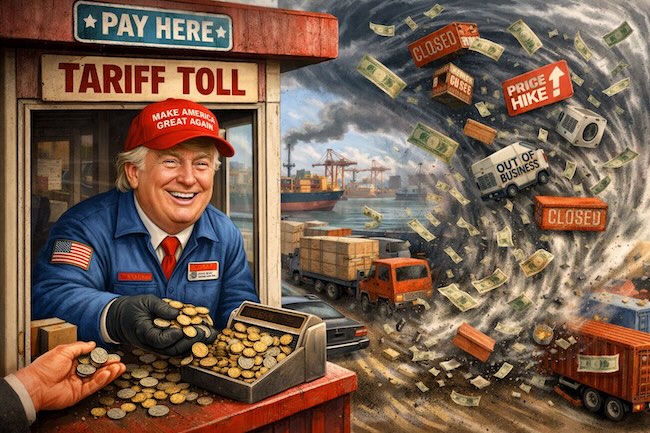
(Image by ChatGPT)
Americans had a huuge year in 2025.
Not a good year, necessarily. But a big one.
It was a year of bold gestures, loud slogans, and economic policies delivered with the confidence of someone who doesn't like math. The nation survived an ambitious experiment in self-discipline known as Liberation Day tariffs, followed closely by a muscular demonstration of border enforcement via mass deportations. Together, these policies delivered excitement, confusion, and a price tag that may be as little as $300 billion, if you don't worry about those pesky knock-on effects like loss of credibility and allies.
Which, in fairness, is not that much money when you’re talking about the United States. It’s only about the size of a small war, a medium pandemic response, or several years of student loan forgiveness that everyone pretends is impossible.
Liberation Day: Freedom Isn’t Free, But It Is Taxable
The Liberation Day tariffs arrived in April 2025 with great fanfare. The idea was simple and elegant: tax imports heavily, force foreigners to pay, revive domestic industry, and possibly make steel manly again.
What happened instead was also simple: Americans paid.
Between April and September, U.S. businesses and consumers absorbed about $180–200 billion in higher costs. Prices rose. Supply chains seized up. Importers developed new hobbies like paperwork and despair.
The federal government collected roughly $100 billion of this as tariff revenue. That money went straight to the Treasury, where it immediately became indistinguishable from every other dollar already spoken for.
The remaining $80–100 billion didn’t go anywhere useful. It vanished into the great American tradition of inefficiency: canceled orders, delayed projects, retaliatory trade losses, and companies deciding it was safer to just not expand this year.
In short, Liberation Day worked exactly like a very large, very clumsy sales tax that applied only to things Americans buy from abroad. Which, as it turns out, is a lot of things.
Deportations: An Expensive Way to Lose Workers
Then came the deportations.
In 2025, the federal government embarked on a serious effort to remove roughly one million undocumented workers from the U.S. economy. This was framed as restoring order, saving money, and opening jobs for Americans.
It did none of those things cheaply.
First, the direct cost: about $85 billion to arrest, detain, process, litigate, and physically deport people. Enforcement turns out to be expensive, especially when you insist on doing it at scale.
Second, the tax losses: roughly $6–11 billion disappeared from federal, state, and local budgets. That included income taxes, payroll taxes, and Social Security contributions that deported workers had been paying, often without ever being eligible for benefits.
Third, and most important, the economic damage: removing that many workers shrank output by an estimated $120–150 billion in 2025 alone. Construction slowed. Farms lost labor. Restaurants closed early. Childcare became scarcer. Entire sectors discovered that “just raise wages” is not a magic spell.
Jobs didn’t smoothly transfer to waiting Americans. Many jobs simply ceased to exist. Businesses scaled back, delayed expansion, or shut down entirely. This is what economists mean when they say “lost output,” which is a polite way of saying “we made less stuff and everyone was poorer.”
Total cost of deportations in 2025: roughly $210–240 billion.
Add It All Up and Admire American Resilience
Put tariffs and deportations together and you arrive at the year’s grand total: around $300 billion in net economic losses.
That figure includes:
money spent enforcing deportations,
taxes no longer collected,
business activity that never happened,
trade that never occurred,
growth that never materialized.
It does not include long-term damage, lost investment, or the emotional cost of explaining to shareholders why “policy uncertainty” is now a permanent line item.
Americans complained, adapted, paid more, earned less, and moved on. This is what happens when you have a population accustomed to absorbing policy whiplash.
Okay, survival isn't the same as success, but Trump gave it the old college try, so who can fault him?
The Lesson of 2025
If 2025 proved anything, it’s that America is still rich enough to endure policies that make it poorer. The country can absorb hundreds of billions in self-inflicted damage and still function.
Liberation Day tariffs didn’t liberate consumers from higher prices. Mass deportations didn’t save money or strengthen the economy or improve our safety. Oh well. Both policies delivered exactly what analysts had predicted: higher costs, lower output, and a very expensive lesson in economic gravity.
Americans enjoyed an exciting year. And got away with only about a $300 billion net tab, after deducting the additional liberating tariffs (which they also paid). Live and learn.
© 2026 by Asian Media Group Inc.
Recent Articles
- Samurai Blue Sweep Aside Tunisia, Japan Fans Sweep Monterrey Stadium
- Lebanon Fighting Threatens Switzerland Negotiations
- Danone-Chobani Yoghurt Protein War Underscores GLP-1 Impact
- Italy's Meloni Tells Trump to Focus on His Own Popularity as Row Continues
- Trump Unveils Gifted Qatari 747 As Addition to Air Force One Fleet
- A Warm World Cup Welcome Endears the US to Fans
- China's May Refined Oil Exports Rose from April, Australia Received Agreed Volume
- New Bangladesh Premier to Seek Investments, Jobs in China, Malaysia
- Charles Schwab Working with Cboe to Enter Prediction Market
- Mexico's Love Affair with All Things Korean — Until Thursday's Kickoff