

GoldSea Votes: Tran to Face a Viet Candidate for All-Asian Congressional Race
By J. J. Ghosh | 03 Jun, 2026
This fall two Vietnamese Americans will fight to represent a congressional district built by Vietnamese refugees of both parties.
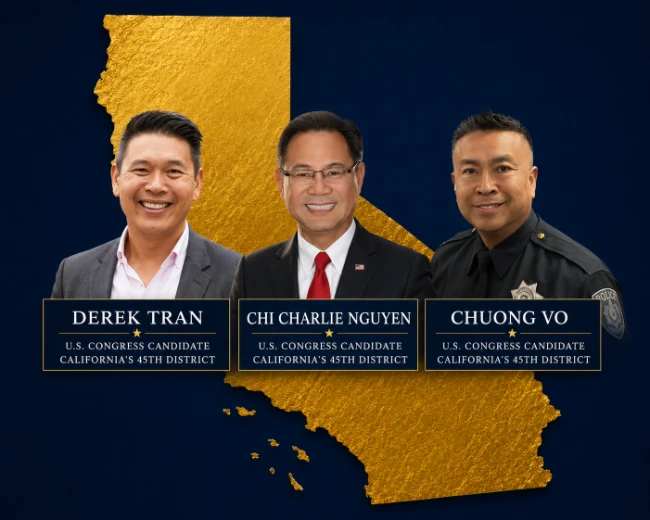
The next Congressman to represent California's 45th Congressional District will be a Vietnamese American.
While we don't yet know who exactly it will be for certain, we do know that five of the top six candidates in Tuesday night's election are Vietnamese — a nearly unprecedented field in a day and age when just 4.4% of the US House is AAPI.
California, of course, operates under the system known as a "jungle primary" in which the top two candidates in a field of contenders advance to the general election, regardless of party.
Incumbent Derek Tran, a Democrat, was hovering around 50% of the vote, leaps and bounds ahead of his closest rivals Chuong Vo and Chi Charlie Nguyen, who were duking it out for the second runoff spot with approximately 15% and 13% each.
This isn't a story about whether AAPI voters matter. This is a story about what happens when AAPI voters are the entire electorate.
How Tran Got Here
Derek Tran's path to Congress is, by any measure, one of the more remarkable political stories of the last decade.
Tran was born in the US to Vietnamese refugee parents. His father fled Vietnam after the fall of Saigon in 1975, but his boat capsized, killing his wife and children. Tran's father returned to Vietnam, where he met and married Tran's mother, and the couple later immigrated to the United States.
Derek Tran defeated Korean American incumbent Michelle Steel by 653 in 2024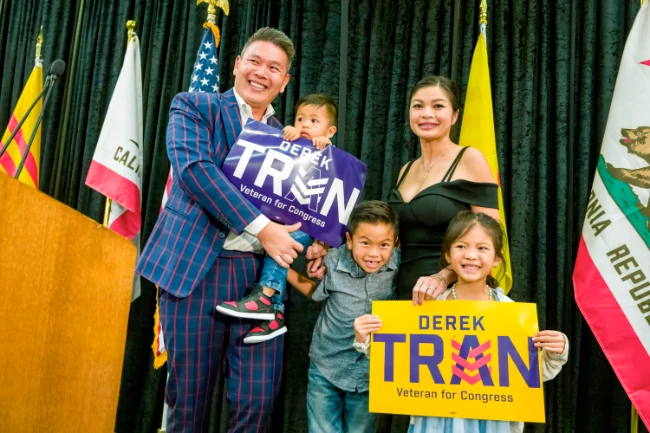
"I grew up on food stamps and Section 8 housing," Tran said at a AAPI Heritage Month event last year. "My community helped me to become a veteran, a business owner, a lawyer, and now the first Vietnamese American Congressman from California."
His 2024 victory was not a comfortable one. Tran defeated two-term Republican incumbent Michelle Steel — a Korean American — by just 653 votes. The race was the third-to-last to be called in the country. He trailed by over 11,000 votes on election night before mail ballots gradually closed the gap over the following two weeks.
"Only in America can you go from refugees fleeing with nothing but the clothes on your back to becoming a member of Congress in just one generation," he said upon winning.
That origin story — refugee parents, food stamps, Army veteran, consumer rights attorney, congressman — has become the backbone of his political identity. And in a district defined by refugee experience, it resonates.
The Field
The Vietnamese American Republican field that assembled to challenge Tran was itself remarkable. Westminster Mayor Chi Charlie Nguyen, Westminster Councilmember Amy Phan West, former Cerritos Mayor Chuong Vo, and taekwondo studio owner Tom Vo all ran as Republicans. Operations analyst Mark Leonard was the only non-Vietnamese American challenger on the Republican ballot.
Each of the Vietnamese American Republicans brought a distinct profile.
Chuong Vo is a retired police officer and former Cerritos mayor who received the backing of several GOP notables including State Senator Tony Strickland. "We truly believe we worked so hard to flee a communist party to come here for American values," Vo told NBCLA. "We have to continue that here." If the current numbers hold, he will finish second and face Tran in November.
Chi Charlie Nguyen, the Westminster mayor, positioned himself as a seasoned public servant with years of local government experience. He seems poised to finish a close third and narrowly miss the runoff.
Amy Phan West, a Westminster councilmember, cited affordability and rising housing costs as her primary motivation for running. Her message tracked closely with the dominant economic concerns of the district.
Tom Vo, the taekwondo studio owner, rounded out the field as the least-known of the four Vietnamese American Republicans.
What Drove Voters
Across the field, affordability and housing costs dominated the policy agenda. This is Orange County, where the cost of living has become a visceral concern for working-class immigrant families who built their lives in communities like Westminster and Garden Grove and are now watching their children unable to afford to stay.
But the race was never purely about housing. The deeper current running through the Republican campaign was the anti-communist identity politics that has defined Vietnamese American conservatism in Orange County for decades. The argument that Vietnamese refugees "worked so hard to flee a communist party to come here for American values" — and that a Democrat therefore cannot authentically represent them — is a powerful emotional claim in a community whose founding trauma is the fall of Saigon.
Tran's answer to that argument is his own biography. His father's boat capsized fleeing Vietnam. He grew up on food stamps. He served in the Army. The refugee narrative is not the exclusive property of the Republican Party in this district, and Tran has spent two years in office making that case through constituent services, bipartisan legislation, and an aggressive local presence.
He also drew criticism from his left flank. VietRISE and other community organizations accused him of not pushing back hard enough on federal immigration enforcement sweeps in Little Saigon — a tension that reflects the complicated politics of a district where anti-communism and immigrant rights advocacy coexist in the same community.
The DCCC made CA-45 one of its earliest 2026 targets, running multilingual print ads in Vietnamese, Chinese, and Korean community papers. Tran headed into the primary with a commanding fundraising advantage, having raised $3.9 million through March 31. Money and party infrastructure helped.
But so did the fact that the Republican vote was split four ways.
What Now
That changes now.
With Chuong Vo emerging as the likely Republican nominee, the anti-Tran vote that was fragmented across four candidates consolidated behind a single opponent. Vo's profile — retired police officer, former mayor, explicitly anti-communist, backed by Republican establishment figures — is a formidable general election argument for this district.
Tran won in 2024 by 653 votes against an incumbent with name recognition and institutional support. He enters this general as the incumbent himself, with the fundraising advantage and the DCCC behind him. Democrats hold an eight-point registration edge in the district, and roughly 25% of voters are registered with no party preference — those independents will likely decide the race.
The general election will be expensive, competitive, and closely watched. It will also be, for the second cycle running, a race in which the fundamental question is not whether a Vietnamese American represents this district — that outcome is already guaranteed — but which vision of Vietnamese American political identity will carry the day.
That is not a small thing. Asian Americans account for about 40% of the district's 750,000 voting-age residents, concentrated in communities whose families came here with nothing and built something extraordinary. Both candidates are descendants of that story. They simply disagree about what it requires of them politically.
November will tell us which argument is more compelling.
Fve of the top six candidates in Tuesday night's election are Vietnamese — a nearly unprecedented field in a day and age when just 4.4% of the US House is AAPI.
Recent Articles
- GoldSea Votes: Tran to Face a Viet Candidate for All-Asian Congressional Race
- US Manufacturing Surge in April Based Entirely on Soaring Aircraft Orders
- AI 'Chipflation' Spreading from Data Centers to Wider Economy
- Targeted Drugs Let More Live with Cancer
- GLP-1 Drugs May Have a Beneficial Effect Across Many Types of Cancer
- Trump Confirms He Called Netanyahu Crazy in Phone Call
- Macy's Raises Annual Forecasts as Luxury Focus Draws Affluent Shoppers
- US Service Sector Growth Picks up in May Despite Higher Prices for Inputs
- US Private Payrolls Rise Broadly in May
- The 4th Time May Be a Charm for the 'New' Keiko Fujimori