

How to Lose the World's Hearts and Minds
By Tom Kagy | 03 Apr, 2026
When an insecure superpower tries to use its might to bully a small unpopular nation and fails, the superpower becomes not so much and the small nation wins the world's respect.
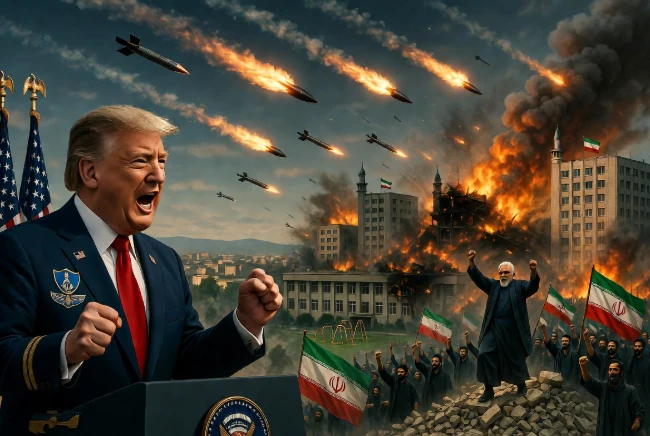
(Image by Grok)
Nobody likes a bully, and everyone loves seeing one embarrassed.
The biggest kid on the playground screams threats at the weird scrawny kid. The scrawny kid just stands there and smirks. The big kid throws a couple of punches and the scrawny kid is still standing smiling. The playground is never the same again.
For the US this has been a recurring nightmare thanks to our uncanny ability to elect spectacularly dumb leadership by picking sound bites over experience and character. And such mediocrities often end up resorting to the same old recipe for losing global influence: take an overwhelming military advantage, mix it with thin-skinned bluster, and aim it at a "rogue" nation that has nothing left to lose.
Art of the Bad Deal
The old-school American playbook was nicely summarized by a true American leader, Teddy Roosevelt: "Speak softly and carry a big stick." The idea was that if you’re actually the most powerful guy in the room, you don’t need to tell everyone. Your silence is terrifying because it implies a true mastery. But lately, the US has swapped that big stick for a megaphone and posts on some fourth-rate social media platform that the press is compelled to visit.
When leadership adopts the Donald-style approach—all caps, "fire and fury," and personal insults—it creates a paradox. By treating a minor adversary as an existential threat or a loathsome enemy on the global stage, you’re elevating them. You’re telling the world that this odd, isolated nation is important enough to make the Leader of the Free World get red-faced with comical bluster.
The North Vietnam Lesson
We've seen this movie before. On paper the US-North Vietnam contest was a mismatch of comical proportions. The US had the nukes, the B-52s, and 20th-century industrial might. North Vietnam was a ragtag collection of revolutionaries and farmers armed with medieval weaponry.
The US mistake was psychological. By framing the conflict as a monumental struggle for the soul of the world, the US gave Ho Chi Minh a platform he could never have built himself. Every time a US official went on TV to talk about "bombing them back to the Stone Age," it didn't make the US look strong. It made us look like a giant flailing at a wasp.
When the US eventually pulled out, North Vietnam didn't just win a war but a moral victory of epic dimensions. The Hanoi gang became the giant killers. The superpower became an insecure bully who’d been thoroughly humiliated. It's a humbling from which we still haven't fully recovered, especially as our lesser leaders keep repeating the same mistakes.
North Korea
In the current century North Korea provided a nice lesson in how bluster backfires. For years the US maintained a policy of strategic patience. It wasn't perfect, but it kept the stick in the background. Then Don introduced the era of "Little Rocket Man" and "my button is bigger than yours."
His schoolboy antics didn't stop the nuclear program. It gave Kim Jong Un exactly what he wanted: a seat at the table of geopolitics. When a US president trades barbs with a dictator of a starving nation, the dictator wins by default. He's now a media heavyweight who gets regular headlines of his own for nothing more than attending some ceremonial event.
Let's not forget that North Korea, too, has nukes and the missiles to deliver them–much of that development occurring during Trump's first term. And, like Iran, it has engaged in more than its share of dangerous rhetoric, often threatening to turn Seoul and Washington DC into a "bed of fire". So why doesn't Trump attack Pyongyang? I won't bother stating the obvious. Bottom line: it's cowardly to punish the weak while backing off stronger targets capable of inflicting more direct damage. Cowardly lack of principle—as much as stupidly bellicose attacks—loses respect and support from a watchful world.
By taking his desperate personal need for attention public, Don signaled to the world that he's an easily-rattled but cowardly egomaniac. And when you’re the leader of a superpower, being rattled is the one thing you can’t afford to be. It turns the big stick—for which we Americans are paying prodigious amounts of our tax dollars—into a foam rubber sword to be derided by current and potential enemies.
The Underdog's Power
The hearts and minds of the global public are, ultimately, what wins the day in any geopolitical contest. Even if a nation is objectively unpopular or ruled by a regime that isn't exactly a champion of human rights, people naturally pivot toward the underdog being bullied by a giant.
When the US uses its might to squeeze a small nation—whether through every sanction we can dream up or military threats—and that nation survives, the narrative shifts. The small nation becomes a symbol of resistance against imperialism. The US, meanwhile, loses its soft power, that ineluctable magic that makes people want to emulate your values. You can't scream someone into liking or supporting you—not even our own NATO allies who have shown a preference to sit this one out.
Why Quiet Power Wins
When the US leans into Don-style threats and bluster, it’s basically admitting that the big stick isn't scary. If our military might were enough to back up our principles, we wouldn't need the silly insults. By pairing 11 aircraft carriers with the rhetoric of an 8th-grader, Don keeps undermining the gravity of our might. Of course he already undermined himself by thinking that air power alone can destroy a regime that's been digging its military assets into hundreds of deep underground facilities for decades.
Other nations—the ones sitting on the sidelines like India, Brazil, or South Africa—are now seeing a superpower that’s easily baited, more concerned with "winning" a news cycle than maintaining long-term stability. They can't help but think, "Maybe the big guy isn't as powerful as he says he is, or as good as he pretends to be."
The Real Scorecard
Hearts and minds aren't won by the loudestguy in the room. They're won by the most fair-minded, humane and reliable.
When the US tries to bully a small nation and fails to get its way, it turns a gratuitous ego-trip into another historic global embarrassment.
We're now reaching the point of this debacle at which our enemies are having trouble suppressing a grin and our friends—the few remaining ones—are looking away in embarrassment.
© 2026 by Asian Media Group Inc.
Recent Articles
- Samurai Blue Sweep Aside Tunisia, Japan Fans Sweep Monterrey Stadium
- Lebanon Fighting Threatens Switzerland Negotiations
- Danone-Chobani Yoghurt Protein War Underscores GLP-1 Impact
- Italy's Meloni Tells Trump to Focus on His Own Popularity as Row Continues
- Trump Unveils Gifted Qatari 747 As Addition to Air Force One Fleet
- A Warm World Cup Welcome Endears the US to Fans
- China's May Refined Oil Exports Rose from April, Australia Received Agreed Volume
- New Bangladesh Premier to Seek Investments, Jobs in China, Malaysia
- Charles Schwab Working with Cboe to Enter Prediction Market
- Mexico's Love Affair with All Things Korean — Until Thursday's Kickoff