

International Stars in the Red Devils' Lineup Suggests a Deep World Cup Run for S. Korea
By MK Choi | 19 Jun, 2026
With more players starring in Europe's top leagues than ever before, South Korea enters the 2026 World Cup with a blend of elite talent, experience and confidence that could carry the Red Devils deep into the tournament.
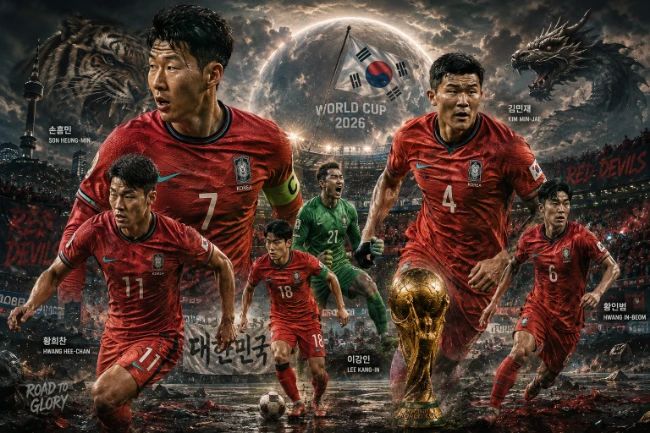
For much of World Cup history, South Korea has been the overachieving outsider. The Taeguk Warriors routinely punched above their weight, relying on organization, fitness and determination to challenge nations with larger talent pools and richer football traditions.
The 2026 edition of the Red Devils feels different.
This South Korean squad isn't merely hoping to spring a surprise. It's built around a core of players who have already proven themselves at the highest levels of world football. From the Premier League and Bundesliga to Ligue 1 and the Dutch Eredivisie, Korean stars are no longer rare curiosities in Europe. They're key contributors, established veterans and, in some cases, genuine stars.
That growing international pedigree suggests South Korea may be poised for its deepest World Cup run since the magical 2002 campaign that carried the nation to the semifinals.
The most obvious reason for optimism remains Son Heung-min.
The longtime captain has spent nearly a decade establishing himself as one of the Premier League's most respected attacking players. Even as he enters the latter stages of his career, Son remains the emotional leader and attacking centerpiece of the national team.
Unlike previous generations of Korean stars who often carried an enormous burden by themselves, Son is no longer forced to do everything.
That's perhaps the most significant change in Korean football.
Supporting him is an increasingly impressive cast of players competing every week against elite competition.
At the heart of the defense stands Kim Min-jae, whose rise from the K League to European stardom has been remarkable. The imposing center back has succeeded in multiple top leagues and developed into one of the world's most respected defenders. His combination of size, speed and technical ability gives South Korea a defensive anchor capable of handling virtually any opponent.
World Cup success often begins with defensive stability. Kim provides exactly that.
In midfield, Hwang In-beom has emerged as one of Asia's most accomplished playmakers. His ability to control tempo, distribute the ball and connect defense with attack has become increasingly important as South Korea evolves beyond its traditional direct style.
The midfield has long been the area where Asian teams struggled against Europe's elite. Today's Korean midfielders are far more technically polished and tactically sophisticated than many of their predecessors.
Then there's Lee Kang-in.
Few players better symbolize the transformation of Korean football.
As a youth prodigy who developed in Spain, Lee possesses the creativity, flair and technical confidence associated with Europe's top academies. He can unlock defenses with a pass, create space in crowded areas and change matches through individual brilliance.
In previous eras, South Korea often relied on collective effort to compensate for a shortage of elite creators. Lee gives the team something it has rarely possessed: a genuine game-breaking talent capable of deciding a match with a single moment of inspiration.
Perhaps even more encouraging is the growing depth around these headline names.
Hwang Hee-chan has become a proven Premier League attacker whose pace and aggression make him a constant threat. Cho Gue-sung offers size and finishing ability up front. Lee Jae-sung brings experience and versatility. Goalkeeper Jo Hyeon-woo remains capable of spectacular performances on the biggest stage.
What separates this squad from many previous Korean teams is that multiple players arrive with experience competing against world-class opposition every week.
That matters enormously in a World Cup.
Players who regularly face Manchester City, Liverpool, Bayern Munich, Paris Saint-Germain and other European giants tend to be less intimidated by the atmosphere and pressure of international tournaments.
The World Cup often rewards teams whose players are accustomed to elite competition.
Croatia, for example, consistently outperforms expectations despite its relatively small population because its best players are embedded in Europe's top leagues. Uruguay has long benefited from the same dynamic.
South Korea increasingly fits that profile.
The growth of Korean football infrastructure has also played an important role.
Youth academies have improved dramatically over the past two decades. More young players are moving abroad earlier in their careers. Coaching standards have risen. Tactical sophistication has expanded.
The result is a pipeline producing players who are comfortable in possession, tactically flexible and technically capable.
That evolution has made South Korea less predictable.
Older Korean teams often relied heavily on relentless running and pressing. Today's squad can still outwork opponents when necessary, but it can also retain possession, build attacks patiently and adapt to different tactical situations.
Modern tournament football rewards versatility.
A team may need to dominate possession against one opponent and defend compactly against another. South Korea's current generation appears better equipped to make those adjustments than many previous editions of the national team.
Another reason for optimism is the team's growing self-belief.
For decades, Asian teams often entered major tournaments hoping merely to remain competitive. That mindset has changed.
South Korea's players increasingly arrive with firsthand experience succeeding in Europe. They no longer view the world's traditional powers as untouchable giants.
They've already beaten many of those players at the club level.
That confidence was evident during South Korea's run to the Round of 16 at the 2022 World Cup in Qatar. The dramatic victory over Portugal demonstrated that the Red Devils could compete with elite opposition when executing their game plan effectively.
The experience gained in Qatar may prove invaluable in 2026.
Many of the key contributors from that squad remain in their prime. They understand the demands of tournament football and know how quickly momentum can build.
Of course, a deep World Cup run is never guaranteed.
The knockout stages are notoriously unforgiving. Injuries, suspensions, bad luck and unfavorable matchups can derail even the strongest teams.
South Korea still lacks the overall depth enjoyed by powers such as France, Argentina, England and Brazil. The margin for error remains smaller than it is for those traditional giants.
Yet World Cups are often defined by teams that catch fire at the right moment.
Morocco's stunning semifinal run in 2022 showed what's possible when talent, organization and confidence align. Croatia has repeatedly demonstrated that smaller nations can challenge football's superpowers.
South Korea possesses many of the same ingredients.
An elite captain. A world-class defender. Creative midfield talent. Proven European professionals. Tactical flexibility. Extensive international experience.
Most importantly, the Red Devils may have assembled the strongest collection of internationally proven players in the nation's history.
That doesn't guarantee a semifinal appearance.
But it does suggest that South Korea enters the 2026 World Cup as more than a dangerous underdog.
For perhaps the first time since the unforgettable summer of 2002, a deep run feels not merely possible but genuinely plausible.
And if the Red Devils do make a serious charge through the knockout rounds, the international stars filling their lineup will be the biggest reason why.
© 2026 by Asian Media Group Inc.
Recent Articles
- Japan's World Cup Prospects Brighter Than Their Single Group Point Might Suggest
- International Stars in the Red Devils' Lineup Suggests a Deep World Cup Run for S. Korea
- Italy's Meloni Says Trump 'Totally Invented' Story That She Begged Him for Photo
- Lebanon Ceasefire Agreed After US-Iran Talks in Switzerland Scrapped
- Qantas Bets on Sleep and Light Science to Sell 20-Hour Flights
- High-Wire Diplomacy Delivered US-Iran Deal but the Tricky Part's to Come
- Pentagon Asks for $80 Billion for Iran War Bills
- Ukrainian Drone Makers Zero in on Demand Created by Taiwan Tensions
- Bedtime Story: Tenali Raman and the Thieves
- Fujimori Edges Toward Peruvian Presidency as Sanchez Calls for Protests