

Our Top-5 Deathbed Regrets and Those of History's Great Asian Leaders
By JL Zhang | 26 Apr, 2026
Our regrets tend to look inward while those of great Asian leaders remain fixed to the end on the unfinished business of their life goals.
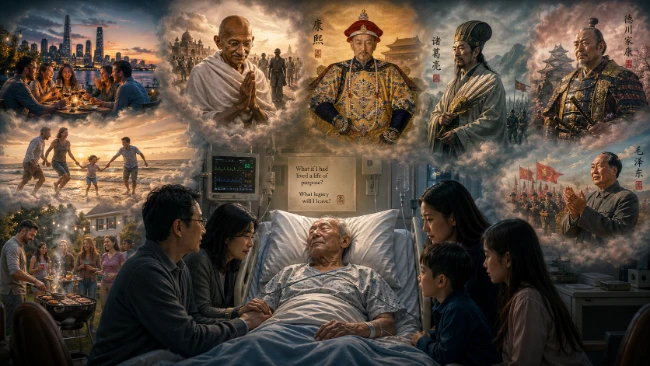
When most of are facing our dying breaths, the evidence suggests that we don't tend to regret the things we did. Rather the regret is centered around what we didn't do. The roads not taken. The words never said. The lives they quietly shelved in favor of the lives they thought they were supposed to live.
Palliative care workers — the nurses and doctors who sit with people in their final days — have heard enough last confessions to draw a pretty clear picture of what we wish we'd done differently. And they're remarkably consistent across cultures, income levels, and life circumstances.
Bronnie Ware, an Australian nurse who spent years working in end-of-life care, famously documented these patterns in her book The Top Five Regrets of the Dying, and what she found is both heartbreaking and clarifying.
What may be of interest to ambition-ridden Asian Americans, our most deathbed regrets may contain an element recorded from history's great Asian leaders — figures like Zhuge Liang, Gandhi, and Emperor Kangxi. Modern American regrets look inward. Those of historic Asian leaders mostly looked outward.
While today's Americans tend to mourn the lives we didn't live for ourselves, they mourned the duties they didn't fulfill for others. Combined, these two views may give us a preview of what we ourselves may encounter at the end of our lives.
Let's start with today's Americans.
1. We Wish We'd Lived Our Own Lives
The number one regret, reported so consistently it's almost eerie, is this: "I wish I'd had the courage to live a life true to myself, not the life others expected of me." People lying in hospital beds, surrounded by the evidence of entire lifetimes, look back and realize they spent enormous chunks of their years performing a version of themselves designed for other people's approval. They took the safe job instead of the passionate one. They stayed in the hometown. They swallowed the dream.
It's deeply personal. It's about the self — specifically, the self that got crowded out by obligation, fear, and the weight of other people's opinions.
2. We Wish We Hadn't Worked So Hard
The second regret flows naturally from the first: almost every person who'd had a career lamented how much of their life they'd handed over to work. Not because work is bad, but because they looked back and realized what they'd traded it for — their kids' childhoods, their marriages, their friendships, Sunday mornings, lazy summers. Things that can't be recovered.
This one hits especially hard for men of a certain generation, though it's increasingly universal. The corner office didn't fill the room the way they thought it would.
3. We Wish We'd Said What We Felt
"I wish I'd had the courage to express my feelings." This is the regret of people who kept the peace at the cost of their own truth. Who swallowed the "I love you" one too many times. Who let the argument sit unresolved because it felt easier than having it out. Who held resentments so long they calcified into part of their personality.
The dying are full of things they never said, and they know it.
4. We Wish We'd Kept Our Friendships
People often grieve the friendships they let quietly dissolve. Not through any dramatic falling out — just the slow erosion of busyness, distance, and distraction. Old friends who knew you when you were young and unguarded and hadn't yet figured out how to perform yourself. Those connections, once lost, can rarely be rebuilt. People realize this too late.
5. We Wish We'd Let Ourselves Be Happier
Fifth, and perhaps the most quietly devastating of all: "I wish I'd let myself be happier." Many people don't realize until the very end that happiness was, to a significant degree, a choice — and they'd been choosing against it out of habit. Staying stuck in complaint, anxiety, and familiar misery because it felt more honest than the alternative. It wasn't. It was just a habit they never broke.
All five of these regrets are personal, about the individual self, its needs, its joys, its authentic expression. They're about relationships that enriched the self, feelings that belonged to the self, happiness that was the self's for the taking. This isn't a criticism — it's simply the shape of the dominant cultural framework in the US and the broader Western world. At our core, Americans have come to believe that the individual life is the primary unit of meaning.
Which is what makes the great Asian leaders' deathbed regrets so striking by comparison.
Great Asian Leaders Looked Outward
Take Zhuge Liang, the legendary Chinese strategist of the Three Kingdoms period, who died in 234 AD. He's one of the most celebrated figures in Chinese history — brilliant, loyal, tireless. And yet his dying words expressed profound sorrow not over anything personal, but over his failure to restore the Han Dynasty. His mission. His duty to his lord and to his people. He didn't lament time lost with family or feelings left unexpressed. He lamented that the work wasn't finished.
Mahatma Gandhi's final months tell a similar story. The man who'd given everything to Indian independence watched the 1947 partition unfold with horror — the communal violence, the mass displacement, the shattering of the unified nation he'd spent his life trying to build. He called it a personal failure. He fasted in protest and grief.
He was assassinated in January 1948, widely regarded as a broken man — not because his personal life had gone wrong, but because the collective outcome he'd devoted himself to had fallen short of his vision. His regret was for his people, not for himself.
Emperor Kangxi of China, one of the longest-reigning emperors in history, left behind a remarkably candid reflection near the end of his life acknowledging that despite 61 years of rule, he'd made countless errors — errors of governance, of judgment, of policy. He lamented the burden of leadership and its cost not to him personally, but to the people under his care. It's considered one of the most honest self-assessments ever left by a ruler, and it's almost entirely outward-facing.
Even figures like Tokugawa Ieyasu, the founder of the Tokugawa Shogunate who unified Japan, reportedly reflected near death on the human cost of his campaigns — the suffering his rise to power had required. Not "I wish I'd spent more time with my family." But "I wish my ascent hadn't cost so many people so much."
But there are exceptions among Asian leaders.
In his final years Mao Zedong reportedly expressed private regret over the catastrophic human cost of the Cultural Revolution and the Great Leap Forward, which caused tens of millions of deaths. Those close to him said he died a lonely and conflicted man.
Emperor Hirohito carried enormous private regret over Japan's conduct in World War II and the suffering the war brought to both the Japanese people and those Japan invaded. He reportedly never fully escaped the psychological weight of those years.
In general though the pattern of outward-looking regrets until the very end runs deep through Asian history and appears founded on a deep sense — embedded in Confucian, Buddhist, and Hindu traditions — of a strong sense of duty to something larger than the self — to family, to community, to dynasty, to the cosmic order.
The individual life derives its meaning not primarily from personal fulfillment but from how faithfully it served its obligations. Confucius himself reportedly lamented near his death that his teachings hadn't been adopted by the rulers of his era — that the world hadn't yet produced the wise king his philosophy pointed toward. His regret wasn't about Confucius. It was about the world.
Two Ways of Tallying Lives
Given the influences we absorb from the modern West and our ancestral East, Asian Americans may face a choice in our final moments.
In the modern Western model — particularly the American one — a good life is largely measured by how fully the individual was expressed. Did you follow your heart? Did you say what you meant? Did you prioritize the relationships that mattered? Did you choose joy? The deathbed becomes a reckoning with the self.
In the Confucian and broader Asian classical model, a good life was measured by how faithfully one served one's role and duty. Did you complete the mission? Did you govern wisely? Did you leave the dynasty stronger than you found it? Did you fulfill your obligations to heaven, to your lord, to your people? The deathbed becomes a reckoning with history.
At the end, however, both mindsets feel the weight of falling short. The dying modern American wishes he'd been truer to himself. The dying Asian leader wishes he'd been truer to his destined role in life.
The course, then, may be to hold both in our minds as we live each day — to be true to the self while remaining bound to something larger. Easy to say. Apparently very hard to do. Most of us only figure out which half we neglected when it's too late to do much about it.
© 2026 by Asian Media Group Inc.
Recent Articles
- Intel Turns to Next-Gen ASML Tool to Help Make Its Laptop Chips
- Cambodian Gaming Tycoon Was Landlord to Chinese Scam Compound
- China New Home Price Slide Slows, but Recovery Doubtful
- Iran Threatens to Block More Vital Seaways as Trump Orders Renewed Iran Blockade
- ASML Beats Q2 Revenue Estimates on AI Chip Demand
- Nvidia Has Begun Shipping H200 AI Chips to China
- IBM Warns AI Boom Is Squeezing Software Budgets; Sending Shares Down
- Two Utah National Monuments Fall to Trump Anti-Green Drive
- 72% of Americans Disagree with Trump on Refugees
- June CPI Not As Hot As Feared, Soothing Markets