

The Simplistic Beliefs Taking the US Down the Road to Poverty, Isolation and Global Scorn
By Tom Kagy | 04 Feb, 2026
If only the deep yearning for simplistic solutions could make them work in the real world Donald Trump might have been a great President.
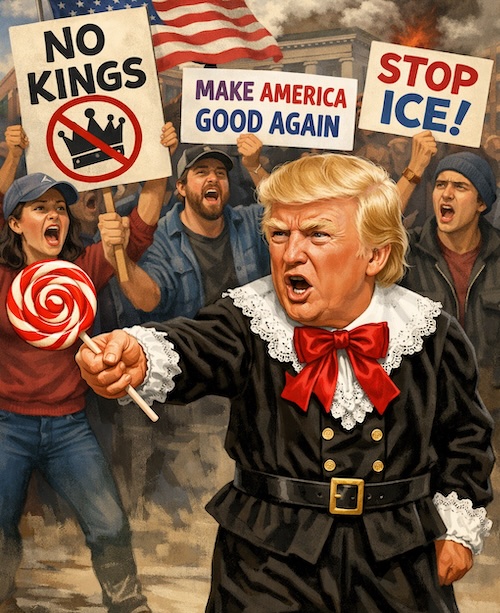
(Image by ChatGPT)
America has always loved simple stories. From frontier myths to rags-to-riches epics, we like narratives with clear villains, obvious heroes, and decisive action. That cultural trait can be a strength when it fuels innovation and confidence. It becomes a liability when it substitutes fantasy for reality in formulating national policy.
The political worldview of Donald Trump isn't evil, or even original. It's simpler, much simpler. It's founded on a small set of beliefs that feel emotionally satisfying, intuitively “tough,” and personally flattering to their holder—but that collapse on contact with reality.
When these beliefs are elevated from personal instinct to national doctrine, the result isn't renewal, or even reversion to some notional glory day, but steady national decline.
This isn't about Trump's tone, manners, or personality. It's a critique of the simplistic beliefs which, if acted on, send the country toward economic stagnation, diplomatic isolation, and global ridicule.
1. A country works like a business and the president is its CEO.
This analogy is endlessly repeated because it sounds practical. Businesses cut costs. Businesses fire underperformers. Businesses break bad deals. Therefore, a country should do the same.
In reality a nation is nothing like a firm. A business exists to maximize profit for owners. A country exists to manage competing interests, provide public goods, and preserve long-term stability. A CEO answers to shareholders; a president answers to a constitution, courts, voters, and future generations.
Businesses can liquidate and reset. Nations can't. When leaders apply “CEO logic” to a republic, they inevitably treat laws as obstacles, civil servants as dead weight, and allies as disposable vendors. The predictable outcome is institutional decay and policy chaos, not efficiency.
2. Trade deficits mean America is losing.
This idea is an economic superstition of the untutored. Trade deficits largely reflect consumer demand, currency strength, and capital inflows. The United States imports more than it exports because Americans are wealthy and because the dollar is the world’s reserve currency. Foreigners sell goods to Americans and reinvest the dollars back into US assets. That isn't exploitation; it's a vote of confidence.
Tariffs imposed to “fix” trade deficits don't punish foreign countries. They tax American consumers and manufacturers. They raise prices, distort supply chains, and invite retaliation. The belief that deficits are losses leads directly to policies that make Americans poorer while claiming victory through accounting illusions.
3. If something is bad, ban it or threaten it to make it go away.
Immigration? Shut the border. Drugs? Seal the border. Crime? Threaten harsher punishment. Allies disagree? Threaten withdrawal. Complexity is treated as weakness; blunt force is treated as realism.
But complex systems adapt. When legal immigration is restricted, illegal pathways expand. When tariffs rise, supply chains reroute. When threats become routine, they lose credibility. Effective policy works with incentives, enforcement, and institutional cooperation. Threat-based governance produces temporary headlines and long-term dysfunction.
4. Loyalty matters more than competence.
Trump’s governing instinct is deeply personal. Loyalty to him is treated as loyalty to the nation. Dissent, expertise, and institutional norms are treated as treason. This is emotionally understandable in a personal business environment, but it's catastrophic in government.
Modern states function because professionals are loyal to rules, not rulers. Military officers swear to the Constitution, not the president. Regulators enforce laws, not personal wishes. Scientists report findings, not preferred narratives. When loyalty tests replace competence, decisions degrade rapidly. Bad information flows upward or not at all. Mistakes compound. Leaders become insulated from reality, then enraged when reality refuses to cooperate.
Under this worldview foreign policy is reduced to dominance theater. Strength is measured by insults, unpredictability, and public humiliation of partners. Diplomacy becomes a television performance rather than a patient exercise in leverage and trust. Allies are treated as freeloaders. Adversaries are treated as rivals in a reality show standoff.
Actual power works differently. The United States became dominant not because it was feared, but because it was reliable. Allies aligned with it because commitments were honored. Markets trusted it because rules were stable. When unpredictability becomes policy, allies hedge, rivals probe, and American influence shrinks. The world doesn't admire chaos; it exploits it.
5. Personal instinct beats expertise.
Trump openly dismisses economists, scientists, intelligence analysts, and diplomats in favor of gut feelings and anecdotes. Expertise is caricatured as elitism; data is dismissed as opinion. This creates a comforting illusion of authenticity, but its indistinguishable from willful ignorance.
Complex societies require models, evidence, and institutional memory. Personal instinct may guide a negotiation; it cannot guide a macroeconomy, a pandemic response, or a global alliance system. When leaders reject expertise, they aren't empowering ordinary people—they're flying blind.
This belief is nothing more than a profound hostility toward constraints, and, ultimately, to reality itself. Courts, inspectors general, independent agencies, and the press are portrayed as enemies rather than safeguards. Any check on executive action is framed as sabotage. This is truly a childish view of power: if you can't do whatever you want, someone must be cheating.
In reality, constraints prevent disastrous decisions made in anger, ignorance, or vanity. Democracies survive precisely because leaders can't act on impulse. Remove the guardrails and the system becomes brittle. Mistakes become crises. Crises become justification for more power grabs.
6. Popularity equals correctness.
Most damaging of all may be the deep conviction that Loud crowds, viral clips, and polling bumps are proof of wisdom. But popularity measures emotional resonance, not truth. The policies that feel best in the short term—tariffs, bans, purges, threats—often carry the highest long-term costs.
This addiction to applause turns governance into spectacle. Performance replaces planning. Optics replace outcomes. By the time the damage becomes visible, responsibility is deflected onto enemies, traitors, or foreigners.
Collectively this set of simplistic—not to say childish—beliefs form a worldview in which reality is expected to submit to assertion. If America declares itself strong enough, rich enough, tough enough, then it will be so. When outcomes disappoint, the failure is never the belief itself—it is insufficient loyalty, insufficient force, insufficient domination.
History isn't kind to nations that govern this way. Economies built on grievance and fantasy lose competitiveness. Talent emigrates. Currency weakens. Alliances erode. Global respect turns into mockery. Poverty doesn't arrive overnight; it seeps in through higher prices, lower investment, weaker institutions, and shrinking opportunity.
These childish ideas resonate because to the masses of Americans who never set stock by learning see them as clarity in a confusing world. They promise control without sacrifice and victory without complexity. They flatter national pride while undermining national strength.
If yearning for simplicity were enough to make policies work, Trump might indeed have been a great president. But reality doesn't reward blustering confidence but coherence, humility, and competence. Nations that forget this lesson decline while loudly insisting on their greatness as the world quietly move on.
We're now at a point where the danger is childish thinking that concentrates power in the hands of a childish thinker. The road to poverty, isolation, and global derision is paved not with malice, but with simplistic beliefs that feel good, sound tough, and fail every time they meet the real world.
© 2026 by Asian Media Group Inc.
Recent Articles
- Samurai Blue Sweep Aside Tunisia, Japan Fans Sweep Monterrey Stadium
- Lebanon Fighting Threatens Switzerland Negotiations
- Danone-Chobani Yoghurt Protein War Underscores GLP-1 Impact
- Italy's Meloni Tells Trump to Focus on His Own Popularity as Row Continues
- Trump Unveils Gifted Qatari 747 As Addition to Air Force One Fleet
- A Warm World Cup Welcome Endears the US to Fans
- China's May Refined Oil Exports Rose from April, Australia Received Agreed Volume
- New Bangladesh Premier to Seek Investments, Jobs in China, Malaysia
- Charles Schwab Working with Cboe to Enter Prediction Market
- Mexico's Love Affair with All Things Korean — Until Thursday's Kickoff