

Supreme Court Rejects Trump Bid to Restrict Birthright Citizenship
By Reuters | 30 Jun, 2026
In a 6-3 ruling the Supreme Court upheld a lower court's decision blocking Trump's executive order nullifying the citizenship of children born in the United States if neither parent is an American citizen or a green card holder.
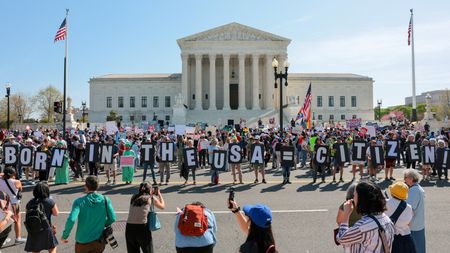
FILE PHOTO: Demonstrators hold letters making up the slogan "Born in the USA = citizen!" outside the U.S. Supreme Court building as the court hears oral arguments on the legality of the Trump administration's effort to limit birthright citizenship for the children of immigrants, in Washington, D.C., U.S., April 1, 2026. REUTERS/Kylie Cooper/File Photo
Handing President Donald Trump a stinging defeat, the U.S. Supreme Court on Tuesday rejected his audacious attempt to restrict birthright citizenship in the United States — a right long woven into the fabric of American society — scuttling one of his top priorities in his crackdown on immigration.
The 6-3 ruling marked the second time this year that the court has invalidated a major Trump initiative, following its February decision to strike down his sweeping global tariffs.
The justices upheld a lower court's decision that blocked Trump's executive order directing U.S. agencies not to recognize the citizenship of children born in the United States if neither parent is an American citizen or legal permanent resident, also called a "green card" holder.
Challengers to Trump's order argued that it violates language in the U.S. Constitution's 14th Amendment that confers citizenship to those born in the United States who are "subject to the jurisdiction thereof."
Trump, who has repeatedly tested the limits of presidential power in domestic and foreign policy, issued the order last year on his first day back in office as part of a suite of policies to crack down on legal and illegal immigration. Critics have accused the Republican president of racial and religious discrimination in his approach to immigration.
The challengers said the Supreme Court already had settled the question of birthright citizenship in an 1898 case called United States v. Wong Kim Ark, which recognized that the 14th Amendment grants citizenship by birth on U.S. soil, including to the children of foreign nationals.
Conservative Chief Justice John Roberts, who authored Tuesday's ruling, pointed to that 1898 ruling.
"Not surprisingly, then, in the 128 years since, we have repeatedly understood the rule of Wong Kim Ark to guarantee citizenship to all children born in the United States and subject to its power," Roberts wrote. "We see no reason to depart from that view today."
Roberts said there was "scant evidence" to support the Trump administration's "dramatically revisionist view" of how to interpret the citizenship language of the 14th Amendment to limit birthright citizenship.
"If Congress intended to limit American citizenship to the children of those domiciled in the United States, nothing in the succinct language of the Citizenship Clause conveyed that design," Roberts wrote.
The Supreme Court weighed in on what it means to be an American citizen just ahead of the July 4 holiday when the United States marks the 250th anniversary of its founding.
Ahead of the ruling, some experts had estimated that Trump's directive could affect the legal status of as many as 250,000 babies born each year and could require the families of millions more to prove the citizenship status of their newborns.
A CLASS-ACTION SUIT
The legal challenge to Trump's directive considered by the Supreme Court, which has a 6-3 conservative majority, involved a class-action lawsuit filed in New Hampshire by parents and children whose citizenship was threatened by the directive.
The 14th Amendment has long been interpreted as guaranteeing citizenship for babies born in the United States, with only narrow exceptions such as the children of foreign diplomats or members of an enemy occupying force.
The provision at issue, known as the Citizenship Clause, states: "All persons born or naturalized in the United States, and subject to the jurisdiction thereof, are citizens of the United States and of the state wherein they reside."
The administration has asserted that the phrase "subject to the jurisdiction thereof" means that being born in the United States is not enough for citizenship, and excludes the babies of immigrants who are in the country illegally or whose presence is lawful but temporary, such as university students or those on work visas.
Citizenship is granted only to the children of those whose "primary allegiance" is to the United States, including citizens and permanent residents, the administration has argued. Such allegiance is established through "lawful domicile," which lawyers for the administration define as "lawful, permanent residence within a nation, with intent to remain."
When the Supreme Court considered the case on April 1, Trump made history as the first sitting president to attend arguments before the top U.S. judicial body, though he left midway through, not long after the lawyer arguing against the administration had begun.
The Supreme Court last year gave Trump an initial victory in the birthright citizenship context in a ruling restricting the power of federal judges to curb presidential policies nationwide. That decision, however, did not resolve the legality of Trump's directive.
Democratic state attorneys general who had pursued their own legal challenge to Trump's birthright citizenship executive order hailed the Supreme Court's decision.
"Today's decision affirms a foundational tenet of American democracy: that every child born in this country, no matter their background, is equal under the law and can pursue the American Dream," California Attorney General Rob Bonta said in a statement.
New York Attorney General Letitia James in a statement called birthright citizenship "a constitutional guarantee that has defined this nation for generations."
'BIRTH TOURISM'
During the arguments, U.S. Solicitor General D. John Sauer, representing the administration, said the promise of citizenship for virtually any baby born on U.S. soil has spawned what he called a sprawling industry of "birth tourism."
Sauer said that "uncounted thousands of foreigners from potentially hostile nations have flocked to give birth in the United States in recent decades" to secure citizenship for their children. Asked to explain how serious an issue "birth tourism" has become, Sauer primarily cited media reports and conceded that "no one knows for sure."
The 14th Amendment was ratified in 1868 in the aftermath of the Civil War of 1861 to 1865 that ended slavery in the United States, and overturned a notorious 1857 Supreme Court decision that had declared that people of African descent could never be U.S. citizens.
During arguments, Sauer described what he saw as the limited purpose of the 14th Amendment Citizenship Clause, saying it was adopted "to grant citizenship to the newly freed slaves and their children, whose allegiance to the United States had been established by generations of domicile here."
AN 1898 PRECEDENT
The administration contended that the 1898 precedent supported Trump's order because, according to the court's ruling in that case, at the time of his birth, Wong Kim Ark's parents had permanent domicile and residence in the United States.
Some of the justices pushed back on that during arguments, with conservative Justice Neil Gorsuch telling Sauer: "Well, I'm not sure how much you want to rely on Wong Kim Ark."
Trump for years had threatened to limit who qualifies for citizenship at birth.
Trump wrote on social media last year: "Birthright Citizenship was not meant for people taking vacations to become permanent Citizens of the United States of America, and bringing their families with them, all the time laughing at the 'SUCKERS' that we are!"
"But the drug cartels love it! We are, for the sake of being politically correct, a STUPID Country but, in actuality, this is the exact opposite of being politically correct, and it is yet another point that leads to the dysfunction of America," Trump wrote.
Concord, New Hampshire-based U.S. District Judge Joseph Laplante in July 2025 let the challenge to Trump's order by the plaintiffs in the case before him proceed as a class, thus allowing the policy to be blocked nationwide.
IMMIGRATION RULINGS
The court's conservative majority has backed Trump on other major immigration-related policies since he returned to the presidency.
For instance, the court on June 25 cleared the way for the Trump administration to strip hundreds of thousands of Haitian and Syrian immigrants of a humanitarian status that protects them from deportation. On the same day, it sided with him by backing the U.S. government's authority to turn away asylum seekers when officials deem U.S.-Mexico border crossings too overburdened to handle additional claims.
In other cases, it let Trump expand mass deportation measures on an interim basis while legal challenges play out, such as ending humanitarian protections for certain migrants, deporting people to countries where they have no ties and carrying out aggressive immigration raids that can target individuals based on their race or language.
The court, however, has not always ruled in Trump's favor. In February, it struck down sweeping tariffs he pursued under a law meant for use in national emergencies. And on Monday it refused to let him fire Federal Reserve Governor Lisa Cook.
Tuesday was the final day of rulings for the court's current term, which began in October.
(Reporting by Andrew Chung; Additional reporting by Nate Raymond; Editing by Will Dunham)
© 2026 by Asian Media Group Inc.
Recent Articles
- Supreme Court Rejects Trump Bid to Restrict Birthright Citizenship
- Ralph Lauren Soars in China As Superfans Embrace the American Dream
- Meituan Says New Trillion-Parameter AI Model Trained on Chinese Chips
- Samsung, SK Hynix Mega Chips Complexes Go Long on AI Optimism
- US Working on Ban Targeting Chinese Energy Inverters
- Ferrari and BMW Join Tesla, China in Switch from Copper to Cheaper Aluminum
- World Cup Is a Seismic Event in Soccer Stronghold California
- Strong Dollar Pushes Yen to 40-Year Low as Traders Test Japanese Authorities
- Canada's GDP Rebounded in April with 0.5% Monthly Growth
- Joby, Toyota Announce Joint Venture for Air Taxi Production