

How Japan Inspired the CIA
By Goldsea Staff | 15 Feb, 2026
The successful surprise attack on Pearl Harbor showed the need for a civilian agency to coordinate intelligence and provide more reliable geopolitical assessments.
On the morning of December 7, 1941, as Japanese aircraft swept over Oahu and the US Pacific Fleet erupted in flames, the United States suffered more than a military defeat. It suffered an intelligence disaster.
The attack on Pearl Harbor exposed a structural weakness at the heart of America’s national‑security system: the country didn’t have a centralized, coordinated intelligence capability that could synthesize information, anticipate threats, and warn policymakers before catastrophe struck.
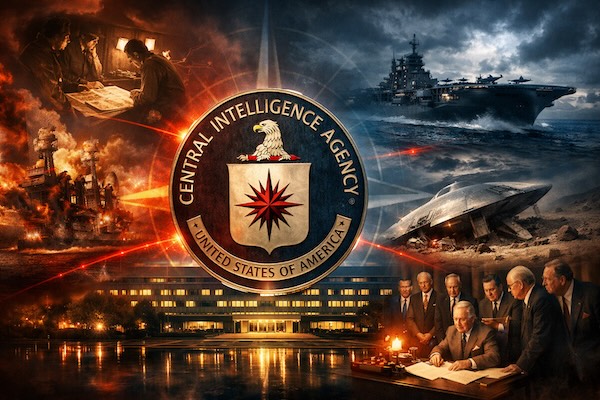
As the United States emerged from World War II as a global superpower and entered the tense early years of the Cold War, the memory of that failure shaped the creation of a new kind of institution—one that would sit above the military services, integrate intelligence from across the government, and provide strategic insight to the president—the Central Intelligence Agency.
The CIA’s creation in 1947 out of trauma, bureaucratic rivalry, geopolitical transformation, and a dawning realization that the United States couldn’t keep operating with the fragmented, parochial intelligence practices of the prewar era. Pearl Harbor was the catalyst, but the story is of a nation forced to rethink how it understood the world and its place within it.
Intelligence Chaos
Before Pearl Harbor, the United States didn’t have a national intelligence agency. Intelligence was scattered across the military services and a handful of civilian offices, each operating independently and often competitively. Army G‑2 focused on ground forces and land‑based threats. Navy ONI concentrated on maritime intelligence and naval operations. The State Department collected diplomatic reporting but didn’t see itself as part of an intelligence system. The FBI handled domestic security but had little interest in foreign intelligence.
These organizations rarely shared information. They had different priorities, different cultures, and different assumptions about America’s role in the world. The United States, still influenced by isolationist sentiment, didn’t see itself as a global power that needed a global intelligence apparatus. The result was predictable: no one had the full picture.
In the months leading up to Pearl Harbor, the US actually possessed fragments of intelligence indicating Japanese intentions—intercepted communications, diplomatic signals, military movements—but no agency was responsible for integrating them. The Army and Navy each believed the other was responsible for certain assessments. The State Department wasn’t looped into military intelligence. The FBI guarded its information jealously. When the attack came, it wasn’t because the United States lacked information. It was because it lacked coordination.
A Shock to the System
The shock of Pearl Harbor reverberated far beyond the battlefield. Congressional investigations, military inquiries, and internal reviews all reached the same conclusion: the United States had failed to “connect the dots.”
The Roberts Commission, the first major investigation, found that intelligence had been scattered across agencies, poorly analyzed, insufficiently shared, and hampered by interservice rivalry. The Army and Navy blamed each other. The State Department blamed the military. The FBI blamed everyone.
But the deeper problem was structural: the United States had no mechanism for producing national intelligence.
President Franklin Roosevelt had already experimented with a centralized intelligence capability during the war. In 1942 he created the Office of Strategic Services, led by William “Wild Bill” Donovan. The OSS conducted espionage, sabotage, and analysis across Europe and Asia. It was the closest thing the US had ever had to a national intelligence agency. But the OSS was a wartime creation, and its existence was controversial. The military distrusted it. J Edgar Hoover despised it. Many in Congress feared it would become an “American Gestapo.”
New Cold War Dangers
When the war ended, President Truman—skeptical of peacetime intelligence services—dissolved the OSS in October 1945. But within months, the emerging Cold War made it clear the United States couldn’t return to its prewar intelligence model. The world had changed. America’s intelligence system hadn’t.
By 1946 the geopolitical landscape had shifted dramatically. The Soviet Union was consolidating control over Eastern Europe. Communist movements were gaining strength in Asia. The US faced a nuclear‑armed adversary with global ambitions.
American policymakers needed reliable intelligence on Soviet intentions, capabilities, and ideology. Yet the United States still lacked a centralized intelligence system. The Army and Navy continued to operate independently. The State Department produced diplomatic reporting but not strategic analysis. The FBI focused on domestic threats.
The result was fragmented information, inconsistent assessments, and no authoritative voice to advise the president. George Kennan’s famous “Long Telegram” in 1946 crystallized the challenge. Kennan argued that the Soviet Union was driven by ideological hostility and strategic opportunism, and that the United States needed a long‑term strategy of containment. But containment required intelligence—deep, sustained, global intelligence.
National Security Act of 1947
President Truman and Congress enacted the National Security Act of 1947. This sweeping legislation created the Department of Defense, established the National Security Council, created the US Air Force, and, crucially, established the Central Intelligence Agency. The CIA was designed to solve the problems that Pearl Harbor had exposed.
Its core missions were to coordinate intelligence across the government, produce strategic analysis for the president, conduct covert operations when authorized, and prevent another Pearl Harbor. The CIA’s most important mandate was to ensure that intelligence failures born of fragmentation would never again leave the nation vulnerable. This was a profound shift. For the first time in American history, intelligence became a permanent, centralized, civilian function of government.
Army and Navy intelligence were good at what they were designed for—supporting military operations. But they weren’t designed to analyze political movements, assess ideological threats, understand foreign economies, evaluate diplomatic trends, integrate intelligence across regions, or provide long‑term strategic forecasting.
A civilian agency could draw on diplomatic, economic, cultural, and political sources. It could think beyond the battlefield. It could provide the president with a broader, more nuanced understanding of the world.
The connection between Pearl Harbor and the CIA isn’t metaphorical. It’s direct, causal, and documented. Pearl Harbor revealed the dangers of fragmented intelligence, the consequences of interservice rivalry, the need for centralized analysis, and the importance of warning and foresight. The Cold War revealed the need for global intelligence, the challenge of ideological adversaries, the limits of military‑centric intelligence, and the necessity of covert influence. The CIA was the solution to both.
The CIA’s creation marked the beginning of the modern American intelligence community. It established the principle that intelligence should be centralized, civilian‑led, strategic, global, and integrated across agencies. This paradigm has shaped US national security for nearly eight decades.
Asian American Success Stories
- The 130 Most Inspiring Asian Americans of All Time
- 12 Most Brilliant Asian Americans
- Greatest Asian American War Heroes
- Asian American Digital Pioneers
- New Asian American Imagemakers
- Asian American Innovators
- The 20 Most Inspiring Asian Sports Stars
- 5 Most Daring Asian Americans
- Surprising Superstars
- TV’s Hottest Asians
- 100 Greatest Asian American Entrepreneurs
- Asian American Wonder Women
- Greatest Asian American Rags-to-Riches Stories
- Notable Asian American Professionals