

Are India's Cockroach Protests the Start of a 1960s US-Style Social Revolution?
By Wes Yamanoha | 22 Jul, 2026
Intense academic pressures coupled with severely limited job opportunities and a growing distrust of officials contribute to a movement likely to grow and become better organized.
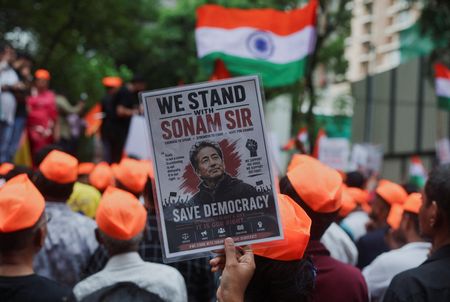
A supporter of the Cockroach Janta Party (CJP) holds a poster of Sonam Wangchuk after authorities moved him to a hospital during his hunger strike, during a protest demanding the resignation of Indian Education Minister Dharmendra Pradhan, in Mumbai, India, July 19, 2026. REUTERS/Francis Mascarenhas
India’s Cockroach movement began with an insult, but it is growing because millions of young Indians feel the insult merely made official what they already suspected: that the system sees them as disposable.
Supporters of the Cockroach Janta Party (CJP) chant slogans and wave their mobile phones with their flashlights on as they gather after the Indian education reformer Sonam Wangchuk, who had been on a hunger strike, was taken to a hospital by authorities on Saturday during a sit-in protest demanding the resignation of Indian Education Minister Dharmendra Pradhan, at Jantar Mantar in New Delhi, India, July 19, 2026. REUTERS/Anushree Fadnavis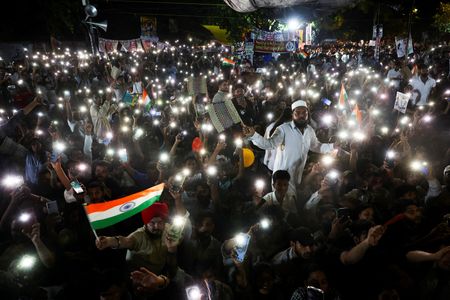
The Insult That Became A Banner
The trigger was a remark attributed to Chief Justice Surya Kant, who likened some unemployed young people to “cockroaches” during a Supreme Court hearing. He later tried to distance himself from the broader interpretation, but by then the phrase had escaped the courtroom and entered the bloodstream of youth politics. A satirical online identity, the Cockroach Janta Party, quickly turned the slur into a flag. Its founder, Abhijeet Dipke, framed the movement as a protest against unemployment, exam scandals and the contempt shown toward young Indians whose lives are being consumed by tests, applications and shrinking chances. Within days of its formation in May, the movement had amassed tens of millions of Instagram followers, according to Reuters and CNA.
Supporters of India's Cockroach Janta Party (CJP) hold placards, two days after thousands of protesters marched towards parliament demanding the resignation of Education Minister Dharmendra Pradhan over examination paper leaks, at Jantar Mantar in New Delhi, India, July 22, 2026. REUTERS/Anushree Fadnavis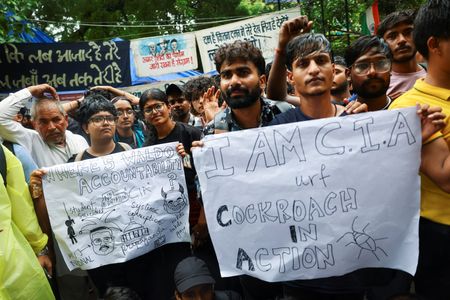
That speed matters. India is no stranger to protest. It has seen farmers’ movements, anti-corruption mobilizations, caste-rights agitations, student uprisings and regional revolts. But the Cockroach movement has a different emotional register. It is sarcastic, wounded, funny, furious and self-deprecating all at once. It is not simply saying, “We demand jobs.” It is saying, “You built a system that forced us to crawl through impossible tunnels, then mocked us for crawling.”
A Generation In The Pressure Cooker
Behind the humor lies a brutal social bargain. Middle-class and lower-middle-class Indian families have accepted years of pressure, sacrifice and deferred pleasure because education was supposed to be the escape hatch. Parents mortgage comfort, children lose adolescence, and whole cities of test preparation turn youthful ambition into an industrial process.
The most coveted degrees and government jobs sit at the end of vast funnels. Millions compete for a tiny number of seats. The exam becomes more than an exam. It becomes a family’s investment thesis, a child’s identity, and often the only socially approved path out of insecurity. That kind of pressure can be tolerable only if the system is believed to be fair.
That faith has been shaken by repeated exam leaks, marking controversies and allegations of corruption. The NEET medical entrance scandal became a central grievance because it struck at the sacred promise that punishing effort would at least be rewarded honestly. Reuters has reported that paper leaks affecting millions helped turn the Cockroach movement from an online joke into a street protest demanding the resignation of Education Minister Dharmendra Pradhan.
For young Indians, a leaked paper is not a technical irregularity. It is a theft of years. It means that the student who studied through illness, anxiety, poverty or family tension may still lose to someone who had access, money or connections. That is why the movement has moral force. It is less about one exam than about a whole generation’s suspicion that meritocracy has become a rigged carnival game.
The Credential Trap
The anger would not be as combustible if education were reliably leading to employment. But India’s education-to-work pipeline has become a maze in which more degrees do not necessarily produce more secure futures.
The State of Working India 2026 report from Azim Premji University says graduate unemployment remains extremely high among young Indians: nearly 40 percent among those aged 15 to 25 and about 20 percent among those aged 25 to 29. It also notes that only a small share of graduates obtain stable salaried jobs within a year of graduation.
That is the background hum beneath the Cockroach movement. India has expanded education, but not enough high-quality employment to absorb the educated. A degree still has value, but the guarantee has weakened. When credentials multiply faster than opportunities, the credential itself becomes devalued. The student is told to study harder, specialize more, take another exam, move to another city, accept another unpaid or underpaid role, or wait for the next hiring cycle.
This produces a peculiarly modern kind of humiliation. The unemployed graduate is not unambitious. Often he or she has done exactly what society prescribed. The wound comes from having obeyed the rules and still being treated as a failure. The “cockroach” label stung because it seemed to invert blame: the young were made to feel like pests inside a system that had consumed their energy without delivering the promised future.
Distrust Becomes The Fuel
The movement is also powered by distrust. Young Indians are not merely frustrated with economic outcomes. They are increasingly skeptical of officials, institutions and media narratives that tell them the country is soaring while their own lives feel stalled.
This is where the movement becomes politically dangerous. A government can survive unemployment if many people believe conditions are improving or that sacrifice is temporary. It can survive exam scandals if people believe bad actors will be punished. It can even survive elite arrogance if citizens think institutions are still basically responsive.
But when unemployment, exam irregularities and official condescension combine, they produce a different mood: the belief that the system is not failing accidentally but protecting itself. That is why the Cockroach Janta Party’s absurd name works. The joke contains a theory of power. Cockroaches live in the cracks. They are despised but hard to eliminate. They multiply in hidden spaces. They survive what more elegant creatures cannot.
The state’s response could intensify that symbolism. Reuters reported on July 19 that police had denied permission for a planned march on Parliament by Cockroach supporters, setting up a possible standoff as Parliament’s monsoon session opened. The same report said activist Sonam Wangchuk’s forced hospitalization after a hunger strike had helped broaden the movement’s appeal.
Movements often grow when authorities confirm their own caricature. If young protesters are treated as a security problem rather than as citizens with grievances, the movement’s claim of contempt becomes easier to believe.
Why The 1960s Comparison Tempts
The comparison to the US in the 1960s is tempting because India now has several of the ingredients that made that decade explosive: a huge youth population, widening mistrust of authority, campus-linked anger, a sense of hypocrisy among ruling elites, and the ability of one issue to activate many others.
In the US, the 1960s were not one movement but a convergence. The civil rights struggle, student activism, antiwar protests, women’s liberation, free-speech battles, Chicano activism, gay liberation and countercultural experimentation reinforced one another. OpenStax describes how student groups, civil disobedience, the Berkeley Free Speech Movement and opposition to the Vietnam War challenged the status quo, while protest movements helped inspire organized demands for women’s rights.
That is the key distinction. The US 1960s became revolutionary because grievances fused into a broader reimagining of authority, identity, freedom and personal life. It challenged who could vote, who could speak, who could marry, who could fight a war, who had control over sex and family, and who got to define respectable citizenship.
India’s Cockroach movement is not yet that broad. Its central emotional demand is fairness: fair exams, fair jobs, fair treatment, fair accountability. That is potent, but it is not the same as a wholesale cultural revolution. It is more anti-corruption than counterculture, more meritocratic than liberationist, more “give us the future we were promised” than “let us invent a radically different way to live.”
Why It Could Still Spread
Even so, the movement has room to grow because its grievances are not narrow. The exam crisis touches education. Education touches jobs. Jobs touch marriage, family formation, migration, mental health, caste mobility, gender roles and faith in democracy.
A young man unable to find stable work may delay marriage, remain dependent on parents and lose status in his community. A young woman facing the same job market may confront both economic anxiety and pressure to abandon ambition for family expectations. Students from poorer or marginalized backgrounds may feel the collapse of exam fairness most acutely because exams were supposed to provide a path around inherited privilege.
That gives the movement many possible bridges. It could connect with parents who feel cheated by coaching costs, with students angry over paper leaks, with graduates trapped in unpaid internships, with aspirants for government jobs, with regional youth movements, with anti-corruption campaigners and with civil-liberties advocates. If it builds local chapters, legal-aid networks, campus groups, volunteer organizers and a serious reform agenda, it could become far more durable than a meme.
The Cockroach movement’s early weakness is also its early strength. It is loose, satirical and online-first. That makes it hard to control and easy to join. But it also makes it vulnerable to drift, factionalism, co-option and burnout. Instagram followers do not automatically become disciplined organizers. A crowd can embarrass a minister; an organization can change institutions.
The Revolution Will Need Institutions
The US 1960s had music, slogans and rebellion, but it also had institutions: churches, student groups, civil rights organizations, unions, legal networks, underground newspapers, campus chapters and charismatic leaders. Without such structures, anger flares and fades.
That is the question now facing the Cockroach movement. Can it turn attention into organization? Can it produce leaders beyond one founder? Can it protect itself from partisan capture while still influencing politics? Can it move beyond a single resignation demand toward concrete reforms in exam security, hiring transparency, youth employment, mental-health support and accountability for officials?
The demand for Dharmendra Pradhan’s resignation may be useful as a rallying cry, but a resignation alone would not solve the underlying crisis. A genuine youth revolution would need to demand auditable exams, severe penalties for leaks, independent oversight, more credible public hiring, better vocational pathways, stronger links between education and industry, and a national reckoning with the mismatch between India’s demographic hopes and its labor-market reality.
Otherwise, the movement risks becoming a mood rather than a force.
A Revolt Of Blocked Aspiration
The Cockroach movement is unlikely to reproduce the US 1960s in cultural form. India is not about to experience a simple replay of American campus radicalism, sexual revolution, hippie counterculture and antiwar rebellion. Its social structure, family expectations, religious landscape, political institutions and economic pressures are different.
But it may produce something equally important in Indian terms: a youth revolt of blocked aspiration. The movement’s power comes from a generation that was told to compete, comply and believe. Now many are discovering that the ladder is narrower than promised, some rungs are broken, and the people guarding the ladder may mock them for trying to climb.
That does not yet make it a social revolution. But it does make it dangerous to dismiss. A movement born as a joke has already revealed a deep reservoir of grievance. If the government treats it as a nuisance, it may remain a nuisance. If the government treats it as an enemy, it may become a cause. And if young Indians succeed in linking exam fairness, job creation, corruption, dignity and democratic rights, the cockroach may become the most unlikely symbol of a new Indian politics.
© 2026 by Asian Media Group Inc.
Recent Articles
- J&J Enters US Robotic Surgery Market After Device Gets Marketing Authorization
- AI Investment Boom Puts Big Tech's Free Cash Flow Under Pressure
- Amazon Cuts Jobs in Its Artificial General Intelligence Group
- Wham!'s Pioneering China Performances and Legacy Become Documentary
- US Punishment of Nicaragua's Election Ban Would Cost Coffee Drinkers Most
- Chinese AI Being Used to Fight Rogue OpenAI Agent
- Indian Exam Protest Forces Parliament Suspension, Pressures Modi
- AMD to Invest up to $5 Billion in Anthropic Which Will Buy up to 2 GW of Chips
- 2nd French Modelling Scout Linked to Epstein Found Dead
- Samsung Unveils Wider Foldable Phone, Hikes Prices