

US Punishment of Nicaragua's Election Ban Would Cost Coffee Drinkers Most
By Reuters | 22 Jul, 2026
US coffee drinkers, already paying the highest prices in a decade, could pay even more if Washington decides to punish Nicaraguan President Daniel Ortega's move to ban elections.
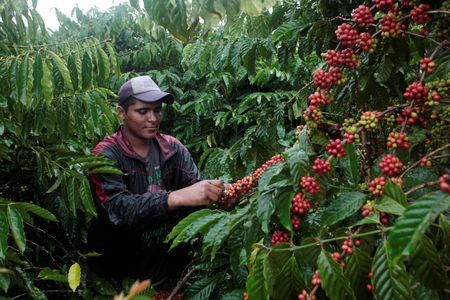
A worker harvests robusta coffee fruits at a plantation in Nueva Guinea, Nicaragua December 29, 2017. Picture taken December 29, 2017. REUTERS/Oswaldo Rivas
U.S. coffee drinkers, already paying the highest prices in a decade, could eventually feel the effects of any reaction by Washington to Nicaraguan President Daniel Ortega's move to ban elections in that Central American country, traders and analysts said.
Coffee is one of Nicaragua's major exports and the U.S. is its largest buyer.
"I wouldn't be surprised," said Mike Nugent, a senior U.S. coffee trader and advisor, when asked if the U.S. administration could restrict coffee buying from Nicaragua, or slap heavy tariffs on that trade.
"Should the U.S. choose to get involved, it risks that Nicaragua could become the target for future trade sanctions," said Marc Schonland, a coffee analyst and consultant to some coffee companies in the U.S., the world's largest market for the beverage.
On Tuesday, U.S. Secretary of State Marco Rubio said Nicaragua should not expect "business as usual" with Washington after Ortega's statement a day before that the country would cease to hold elections.
The U.S. buys 35% of all coffee exported by Nicaragua, according to the U.S. Department of Agriculture. Nicaragua receives half a billion dollars per year for its coffee exports to all countries.
Retail coffee prices in the U.S. remain near the highest levels since at least 2016, according to the U.S. Bureau of Labor Statistics, averaging $9.45 per pound in June.
A ban, or a heavy U.S. restriction, would hurt small farmers in Nicaragua, as well as the country's economy. It would also further squeeze the U.S. coffee market, which has been persistently tight for the last four years. Some of the largest U.S. suppliers have had production shortfalls that have aggravated the effects of President Donald Trump's tariffs.
"There will be certainly the consideration of the coffee community and the economic toll that would take," said soft commodities analyst Judith Ganes.
The National Coffee Association, the industry group for coffee companies in the U.S., has lobbied to keep coffee out of trade restrictions.
It recently succeeded in convincing the government to include instant coffee in a list of exemptions from tariffs, in addition to green coffee beans that were already there.
With two-thirds of Americans saying they drink coffee every day, the item is being watched by Republicans concerned about the rising cost of living ahead of midterm elections in which the party is trying to maintain its slim majority in Congress.
Nicaragua's leftist leader has severely restricted the opposition in recent years, and changed the Constitution last year to establish a one-party system.
(Reporting by Marcelo Teixeira; Editing by David Gregorio)
© 2026 by Asian Media Group Inc.
Recent Articles
- J&J Enters US Robotic Surgery Market After Device Gets Marketing Authorization
- AI Investment Boom Puts Big Tech's Free Cash Flow Under Pressure
- Amazon Cuts Jobs in Its Artificial General Intelligence Group
- Wham!'s Pioneering China Performances and Legacy Become Documentary
- US Punishment of Nicaragua's Election Ban Would Cost Coffee Drinkers Most
- Chinese AI Being Used to Fight Rogue OpenAI Agent
- Indian Exam Protest Forces Parliament Suspension, Pressures Modi
- AMD to Invest up to $5 Billion in Anthropic Which Will Buy up to 2 GW of Chips
- 2nd French Modelling Scout Linked to Epstein Found Dead
- Samsung Unveils Wider Foldable Phone, Hikes Prices