

One Man Holds Back the World's Progress toward Green Energy Sufficiency and Prosperity
By Tom Kagy | 05 Jun, 2026
Between blocks on Chinese solar panels and EVs, offshore wind turbines, approval for oil drilling in Alaskan wildlife preserve, launching a war blocking the flow of Mideast oil while subsidizing the US coal industry, Donald Trump has cost the world crucial years in the race against climate catastrophe.
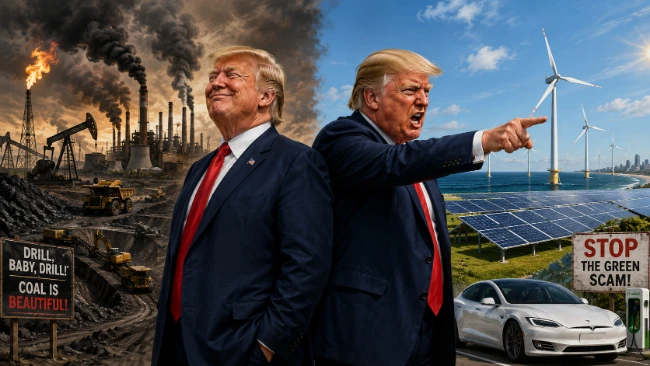
Someday historians may identify a single political figure who did the most to slow humanity's transition to clean energy during the first half of the 21st century: Donald Trump.
That's a remarkable distinction for someone who isn't an oil executive, coal baron, or petrostate ruler. Yet Trump's influence reaches far beyond the United States. As president of the world's largest economy and one of its largest emitters of greenhouse gases, his decisions affect energy investment, manufacturing, technology deployment, and climate policy across the globe.
The tragedy isn't merely that Trump favors fossil fuels as one of many politicians beholden to oil money. He has also repeatedly intervened to block or slow technologies that are already proving themselves cheaper, cleaner, and more scalable than many of the energy sources he favors.
The result isn't just higher emissions. It's a slower path toward a green economy of abundance.
Every year that cheap solar panels, wind turbines, batteries, electric vehicles, and modern power grids are delayed is another year of unnecessarily expensive energy, dirtier air, greater geopolitical instability, and mounting climate risk.
The Solar Slowdown
Trump's hostility toward solar energy goes back to his first term.
His administration imposed tariffs on imported solar products, particularly those originating from China. While the stated goal was protecting American manufacturing, the practical effect was to raise costs for solar deployment across the United States. Studies of Trump's tariff regime found that solar-panel prices rose significantly relative to global markets, slowing installations and increasing project costs.
The second Trump administration has expanded tariff policies even further. Analysts warn that broad tariffs on imported clean-energy equipment, construction materials, and components will make renewable-energy deployment more expensive and delay projects.
China now manufactures the overwhelming majority of the world's solar panels. Whether one likes that reality or not, those factories have driven panel prices down by roughly 90% over the past decade. And humanity desperately needs more solar deployment, not less, as will be attested by the millions living in cities being engulfed by the rising oceans due to melting polar ice.
Every gigawatt of delayed solar power means more fossil-fuel generation remains online.
A War Against Wind
If solar has been treated with suspicion, wind power has been treated with outright hostility.
One of Trump's first major energy actions upon returning to office was suspending offshore-wind leasing and permitting. His administration halted approvals for both onshore and offshore wind projects while conducting reviews that courts later found lacked adequate justification.
The consequences are enormous. Five major offshore-wind projects totaling nearly six gigawatts of generating capacity were frozen or delayed. That's enough clean electricity to power millions of homes. Several states have sued the administration after federal actions terminated or obstructed offshore-wind developments that were expected to create thousands of jobs and supply large quantities of carbon-free electricity.
Offshore wind isn't some speculative technology waiting for a breakthrough. It's already a major source of electricity in Europe and China. Trump's opposition hasn't made the technology disappear. It's merely delayed deployment in the US—the nation best able to afford to fund the green energy transition.
Coal's Resurrection Tour
No energy source better illustrates Trump's worldview than coal. While utilities, investors, and consumers have largely moved on, Trump remains fascinated by what he famously calls "beautiful clean coal."
In June 2026, his administration announced roughly $700 million in new support for coal plants, coal facilities, and coal-export infrastructure using emergency powers.
The economic case is weak. Coal's share of US electricity generation has fallen from nearly 60% in 2000 to less than 20% today because cheaper alternatives have largely outcompeted it.
The environmental case is even weaker. Coal remains the most carbon-intensive major fuel used for electricity generation. Replacing coal with renewables yields some of the largest emissions reductions available in the energy sector.
Yet instead of accelerating that transition, Trump has spent political capital and taxpayer money trying to slow it. That's like subsidizing typewriter factories during the rise of personal computers.
The Alaska Abomination
Trump has also aggressively expanded opportunities for oil and gas development, including projects in environmentally sensitive regions of Alaska.
Supporters frame this as energy independence. The problem is that energy independence isn't the same thing as energy progress.
A society powered by fossil fuels remains vulnerable to fuel-price volatility, geopolitical disruptions, transportation bottlenecks, and the environmental consequences of combustion.
Solar panels don't require tankers crossing oceans. Wind turbines don't depend on pipelines. Batteries don't need drilling leases.
The fastest route to genuine energy security is reducing dependence on fuels altogether. Yet Trump consistently moves in the opposite direction.
How Much Damage Has Been Done?
Nobody can calculate a precise number, but researchers can estimate the scale.
One warning sign emerged in 2025 when US greenhouse-gas emissions rose by approximately 2.4%, reversing several years of declines. Analysts attributed much of the increase to higher fossil-fuel use, including increased coal generation.
Meanwhile, renewable-energy projects representing gigawatts of potential clean generation have been delayed, suspended, or canceled due to federal actions affecting wind permitting and development.
The cumulative effect likely amounts to tens of millions of tons of additional carbon dioxide emissions over coming years.
Some benchmarks help illustrate the magnitude.
Industry estimates suggest that solar deployment enabled by the Inflation Reduction Act alone could avoid an additional 665 million metric tons of carbon emissions over a decade compared with a scenario lacking those investments.
Any policy that significantly slows renewable deployment moves the world away from those avoided emissions and toward greater climate damage.
The Cost of Delay
Climate discussions often focus on catastrophe. But an equally important issue is prosperity. The clean-energy transition isn't merely an environmental project. It's an economic one.
Solar power has become one of the cheapest sources of electricity in human history. Battery prices have collapsed. Electric vehicles increasingly offer lower operating costs than gasoline vehicles. Wind power can provide vast amounts of energy without fuel costs.
Every year that deployment slows means consumers continue paying more for energy than necessary. Businesses face higher operating costs. Manufacturing remains less competitive. Air pollution remains higher, driving up health-care costs. The world remains poorer due to Trump's anti-renewable policies that go beyond increasing emissions to postpone abundance.
The Global Impact
Because the United States remains such an influential market, Trump's actions reverberate globally.
Tariffs influence manufacturing decisions. Federal policy influences investment flows. Diplomatic signals influence international negotiations.
When Washington signals hostility toward clean energy, capital becomes more cautious. Projects become harder to finance. Supply chains expand more slowly. Innovation diffusion slows down.
The effects aren't confined to American borders but spread across the world. A president who opposes renewable-energy deployment can affect climate outcomes far beyond his own country.
A Lost Decade?
Future historians may ultimately conclude that the greatest cost of Trump's energy policies wasn't any single regulation, subsidy, tariff, drilling permit, or coal bailout, but the valuable time lost.
Climate change is governed by cumulative emissions. Every year matters. Every delay matters. Every gigawatt matters.
The world possesses most of the technologies needed to dramatically reduce emissions while improving living standards. Solar panels, wind turbines, batteries, electric vehicles, advanced transmission systems, heat pumps, and modern nuclear technologies already exist.
The challenge isn't invention but policies that encourage deployment, governments that accelerate rather than obstruct.
Trump's legacy in energy may therefore be measured not only in additional carbon released into the atmosphere but in opportunities missed: cleaner air, cheaper electricity, greater energy security, faster innovation, and a more prosperous world that arrived years later than it otherwise might have.
That's a high price for one man's indifference to the cost of chaining the US to 20th-century energy sources the world can no longer afford.
Recent Articles
- Your Answers to These 7 Questions Will Reveal Whether You're Sane or a Closet Lunatic
- US Oil Companies Profit from Strait of Hormuz Closure Says Russian Oil CEO
- Trump Faces New Republican Resistance in Congress as Midterms Approach
- SpaceX IPO Already Two Times Oversubscribed
- SpaceX Signs Google As AI Compute Client After Landing Anthropic
- $1 Trillion in Stock Market Valuation Erased by AI Chip Selloff
- Anthropic Urges Industry Pause As AI Nears Recursive Self-Development
- Trump's South Lawn UFC Birthday Bash to Mix Politics with Punches
- Trump Policies Targeting 39 Nationalities of Immigrants Invalidated
- One Man Holds Back the World's Progress toward Green Energy Sufficiency and Prosperity