

Robotic Tech Dresses Wearer Automatically
By Reuters | 16 Jul, 2026
The technology developed by researchers at South Korea's KAIST and Stanford University uses soft and flexible "vines" powered by air pressure embedded in clothing to close up on the wearer's body even if he isn't standing still.
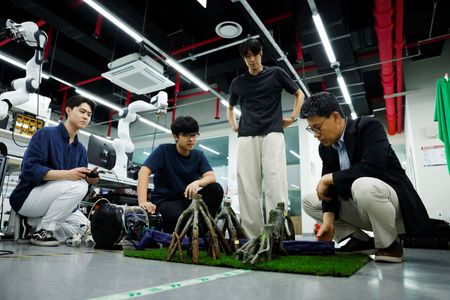
Park Shinwoo, PhD student of Civil and Environmental Engineering at the Korea Advanced Institute of Science and Technology (KAIST), Kim Nam Gyun, a postdoctoral researcher at KAIST and a soft robotics engineer, Hwang Jae Yun, a graduate student of Civil and Environmental Engineering at KAIST, and Ryu Jee-Hwan, a professor of civil and environmental engineering at KAIST, demonstrate a soft-growing robot as it extends between model tree branches at KAIST in Daejeon, South Korea, July 14, 2026. REUTERS/Kim Soo-hyeon
A team of South Korean and U.S. researchers has unveiled a robotic technology that allows a person to suit up without using their hands or aid from others, with potential for applications in chip cleanrooms and emergency services.
The technology developed by researchers at South Korea's KAIST and Stanford University uses soft and flexible "vines" powered by air pressure embedded in clothing. When pressurised, the vines glide the fabric up close to the wearer's body like an ivy plant climbing on a structure, even if the person does not remain standing still.
"When I was riding a bicycle, it started to rain ... and I thought it would be helpful if a raincoat could be put on automatically (as I ride)," said KAIST postdoctoral researcher Kim Nam Gyun, the lead author of a paper on the technology.
"The vine robot stays close to the person and dresses them by turning the clothing inside out as it moves, allowing it to climb stably along the shape of the body,” Kim said, adding it takes about 10 seconds to put on a full suit.
A key to the technology's potential is it does not require the wearer to stand motionless and it works without a complex control algorithm, the researchers said.
Inspired by climbing ivy, the robot advances by growing at its tip rather than shifting its whole body, enabling stable movement along curved surfaces, said Ryu Jee-Hwan, a professor of civil and environmental engineering at KAIST.
“It can pass through narrow gaps, grow while adapting to the shape of its surrounding environment, and move regardless of whether the surface is slippery, sticky, or sloped,” he said.
Beyond immediate applications for helping the elderly and disabled, the team sees potential for use where the user needs to suit up and off quickly and without using the hands, including in semiconductor cleanrooms and by emergency workers requiring personal protective equipment.
Ryu said given the explosive growth of AI, there was usually much attention on the software powering systems, but the team's self-dressing robot was an example of how mechanical engineering could complement software.
The study was published in IEEE Robotics and Automation Letters, a peer-reviewed journal.
(Reporting by Minwoo Park; Editing by Jack Kim and Jamie Freed)
© 2026 by Asian Media Group Inc.
Recent Articles
- Xi Pitches China as Leader of New Global AI Order
- Robotic Tech Dresses Wearer Automatically
- China's Moonshot Unveils World's Largest Open AI Model
- ABC, NBC, CNN Don't Air Trump Election-Security Speech
- Expending Costly, Scarce Ordinance Produces Zero Sign of Iran Progress
- Kalshi to Take Bets on Clinical Trials, FDA Decisions
- Short Sellers Notch $8.7 Billion Profit on SpaceX Shares Plunge
- Trump Tightens Visa Periods for Foreign Students, Cultural Workers, Journalists
- US Weekly Jobless Claims Dip Slightly As Labor Market Unchanged
- Micron Signs Deals to Supply AI-powered Automobile Chip Components