

The 4th Time May Be a Charm for the 'New' Keiko Fujimori
By Reuters | 03 Jun, 2026
Her father Alberto's controversial legacy may help or hurt conservative Keiko Fujimori currently favored to win Peru's presidency in Sunday's runoff vote.
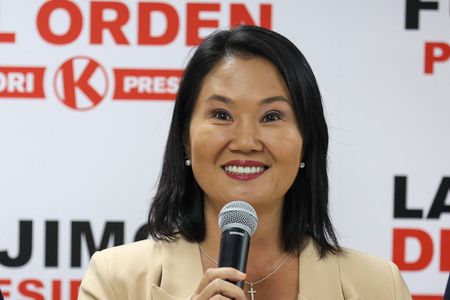
Popular Force presidential candidate Keiko Fujimori holds a press conference after the National Jury of Elections (JNE) announced that she will advance to a runoff election on June 7, in which she will compete for the presidency of Peru against candidate Roberto Sanchez of the Juntos por el Peru party, in Lima, Peru, May 17, 2026. REUTERS/Alessandro Cinque
Conservative Keiko Fujimori will seek Peru's presidency on Sunday in a runoff vote, hoping that her tough-on-crime stance at a time of rising insecurity will outweigh a polarizing family legacy with voters.
Fujimori, 51, secured the highest share of the vote in the first round of the election in April, with 17.17% support. She will face leftist congressman Roberto Sanchez, who narrowly secured second place with 12.03%.
This is Fujimori's fourth attempt at the presidency. In her most recent bid, in 2021, she was defeated by leftist Pedro Castillo, who was later removed from office after attempting to dissolve Congress. Castillo has endorsed her runoff rival from jail.
Fujimori carries the heavy burden of her surname. Her late father, Alberto Fujimori, was president of Peru from 1990 to 2000. A divisive figure, some credited him for bringing stability to the country but opponents criticized him as autocratic. He spent 16 years in prison for human rights abuses committed when he was in power.
After previously distancing herself from her father's political legacy, Fujimori has increasingly leaned into it, now embracing his image as a strongman. She is casting herself as the candidate best able to restore order and stability, as Peru grapples with rising rates of homicide and extortion, a key concern for voters.
"We will work with financial institutions ... to identify, track and block money from extortion," she said during a runoff debate.
Still, her party is keen to draw distinctions between Fujimori and her father. Luis Galarreta, her vice-presidential running mate, said that Fujimori senior was intensely skeptical of political parties, often creating new parties for each election rather than building a lasting organization.
"Keiko is different," Galarreta said in an interview with Reuters. "She believes in having a strong, formal party organization - building institutional political structures."
A 'NEW KEIKO'
Keiko Fujimori spent years under investigation over campaign financing allegations, which were dropped last year. She was held in pretrial detention twice, between 2018 and 2020, spending nearly a year and a half in jail.
Galarreta said the experience reshaped her outlook, making her more reflective, mature and focused on family life.
"We talk a lot about a 'new Keiko,'" Galarreta said. "She is more open, more herself, as a person, as a friend."
Galarreta described Fujimori as "chancona" - a Peruvian term meaning studious and diligent - saying he has seen her help her two daughters with schoolwork and prepare their lunches, even amid a demanding campaign schedule.
Her time in prison also left unexpected personal marks. "She really loves cats now," Galarreta said. Fujimori warmed to them while in jail because they helped keep rats away.
"She didn't like cats before, and now she has four."
Fujimori entered public life as a teenager, serving as de facto first lady from the age of 19 during her father's presidency after her parents separated.
She later studied business administration in the United States and went on to establish her own political base. In 2006, she was elected to Congress with the highest vote total ever recorded for a Peruvian lawmaker. She lost in three presidential runoffs by narrow margins to different contenders in 2011, 2016 and 2021.
RUNOFF CHALLENGES
Despite her experience, one of Fujimori's biggest challenges remains her high rejection rate, though opinion polls show it has eased in recent months. According to pollster Ipsos Peru, 40% of voters in May said they would definitely not support her in a runoff, down from about 59% ahead of the first round.
As well as her family legacy and lingering anger over the corruption allegations, opponents say her right-wing Popular Force party - a dominant force in Congress - has repeatedly blocked reforms. Hundreds of left-wing supporters and civil society groups marched in Lima on Saturday in protest against Fujimori.
"The anti-Fujimori vote is the factor that explains why Keiko Fujimori has fallen short of the presidential palace in three consecutive elections," said historian and analyst Daniel Parodi.
"I sense that this anti-vote has declined — the question is by how much."
(Reporting by Marco Aquino and Lucinda Elliott. Editing by Cassandra Garrison and Rosalba O'Brien)
Recent Articles
- US Manufacturing Surge in April Based Entirely on Soaring Aircraft Orders
- AI 'Chipflation' Spreading from Data Centers to Wider Economy
- Targeted Drugs Let More Live with Cancer
- GLP-1 Drugs May Have a Beneficial Effect Across Many Types of Cancer
- Trump Confirms He Called Netanyahu Crazy in Phone Call
- Macy's Raises Annual Forecasts as Luxury Focus Draws Affluent Shoppers
- US Service Sector Growth Picks up in May Despite Higher Prices for Inputs
- US Private Payrolls Rise Broadly in May
- The 4th Time May Be a Charm for the 'New' Keiko Fujimori
- Global Smartphone Market Faces Record Annual Decline as Chip Crunch Worsens