

What Japan Gets Right About Everyday Life
By Kelli Luu | 07 Jun, 2026
After visiting Japan, I came home with a long list of things she wishes America would adopt. In this episode, we break down the cultural differences and everyday conveniences that make Japan one of the most unique countries in the world.
Kelli (00:01)
Hi everyone, welcome back to the Goldsea Podcast. I'm Kelli and today is going to be the second episode of my podcast series about my recent trip to Japan.
I wanted to talk about one of my favorite parts of visiting Japan, and it was really about all of the little everyday things that I was seeing there that stood out the most.
Things that aren't necessarily tourist attractions, but these are going to be things that just made daily life feel easier, cleaner, safer, and really just more thoughtful. After spending about nine days in Japan, I kept finding myself saying, Why don't we have this back home? and the longer I stayed, the longer my list became. So today I'm going to be sharing everyday things that I experienced in Japan.
that I genuinely think the United States could learn from.
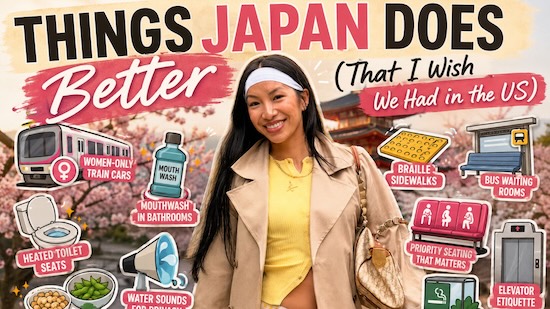
Starting off with one of the most amazing things that stood out to me were women-only train cars. So if you have ever been to Japan, you know that the train transportation is amazing.
There are so many trains going to so many different destinations, and there are specific train cars that are reserved for just women during those busy commuting hours.
It literally says women only on the outside of the train car. And it made me realize how much peace of mind women must have taking these train cars.
The train system moves millions and millions of passengers every day. And during those rush hours, those trains can get so crowded. You sometimes might have to squish in and be touching another person. And honestly, the women-only cars must have been created to help address harassment. And overall it's just making commuting more comfortable for women.
It was really one of those things that made me feel like someone had actually considered the passenger experience of a woman specifically. And in the United States, we spent so much time talking about public safety, especially when it comes to public transit, but we do not have a woman.
only train car.
I've never seen women only train cars. I wouldn't say Japan's solution is perfect, but I thought it was really interesting to see a country actively trying to address issues of public safety rather than just simply accepting it as a part of everyday life.
the train
station is effective. It's efficient and it's just so punctual. You do not have to have a car in Tokyo because you can get everywhere on that train.
you can get across major cities. it doesn't just move people, it gives people that freedom. Students, seniors, employees, tourists, everybody can navigate this train system flawlessly.
Whereas in American cities,
You probably still need a car for almost every aspect of daily life. In Japan they have it down. They have the itinerary and they are not messing up. Their trains are clean, they're efficient, and I'm telling you, when you get to Japan, you will not need that car. That transportation system.
will definitely be your best friend.
Another thing I noticed about the trains is how seriously people take priority seating. So on the trains, many seats have priority seating signs. On these trains, these seats are reserved for elderly, pregnant women, people with disabilities. And in America, some people will see.
those kinds of things signs like this are treated as suggestions but in Japan they're rules
and the people there respect them. Not once did I see somebody who was not over the age of 60 years old sit in that priority seat. I even remember one time.
People have so much respect for the rules. They have so much respect for the transportation system that Japan has. And just the fact that they can follow this simple rule without any problem just really shows, just really reveals a larger cultural value.
Continuing with the whole public transportation idea.
This next thing was so simple, but I absolutely loved it. It was bus waiting rooms. Most of the bus stops that I saw, they had actual waiting rooms. So whereas here you'll see a bus stop, but it's tiny and only like two or three people can sit on that bench.
In Japan, they had actual bus waiting rooms where you can go inside and sit down in a nice chair and wait for the bus to come. And all you have to do, once you see the bus outside, you get up, you walk outside, and you get on the bus. This was a place to sit. It gives you AC on a hot day. It gives you that protection from the rain.
This isn't even a complicated idea. This is truly just a thoughtful one.
Alright, next is the heated toilet seats that I saw everywhere. So not only were the heated toilet seats in the hotel room, they are everywhere in Japan. So here, toilet seat covers are very common. In Japan, they're not common at all. It was nearly impossible to find a toilet that had a toilet seat cover. And I realized the reason why is because Japan holds their citizens accountable for cleaning up after themselves when they use the restroom. Wow, shocker.
Yeah.
I feel like in America, the public restrooms can get so dirty. It's disgusting. It's just incredible how dirty the restrooms here can get. In Japan, they hold everyone accountable and these citizens actually do it. There is a sanitizing station inside of each stall that you use to sanitize.
the toilet seat after. And that is the reason why there are no toilet seat covers because everybody is wiping down the toilet seat after they use it.
The very first time that I saw the public restroom in Japan, it was at the train station and I was very iffy. I was like, I really don't want to sit down on this seat. There's no toilet seat covers. I tried to, I wasn't, I wasn't really feeling it, but as soon as I sat down and I realized it was a heated toilet seat, I understand now why people never stop talking about them because this is definitely a small luxury
Make such a big difference, and Japan has completely normalized this kind of comfort in a way that America doesn't. And after experiencing it, I do not even want a regular toilet seat anymore. I definitely, since I've been back, have been looking into heated toilet seats with the bidets because these completely surprised me.
Another thing that completely surprised me about the bathroom features were the water noises that we're playing. So there are buttons on the toilet systems in the stalls in public restrooms that have water noises. So if you push the button, it'll start playing a water noise for relaxation and honestly for privacy too. Because if you have ever been in the restroom and it's just you and somebody else walks in, you know, those noises can be a little bit awkward, but in Japan, they totally think.
about that and have you covered so they have a button that will play water noises and water sounds so that you have full privacy while you're using the restroom. Again very thoughtful very practical
Another thing I noticed about the bathrooms in Japan is that a lot of them had mouthwash
This wasn't in every single bathroom that I went into, but many of the restaurants and many of the bathrooms in restaurants and in bars, they have mouthwash in the bathroom. Complimentary. Not something you expect, but honestly, after eating a big meal or even getting some drinks, it's so convenient. If you don't have gum, they have mouthwash in the bathroom. I noticed that
Japan does like to focus on helping people feel presentable. You wanna feel comfortable and be presentable throughout your day.
These are just little touches that make public spaces feel so much better and more accommodating because I have never seen mouthwash in a bathroom here in America.
Speaking of the bars and restaurants, another discovery that I noticed were all of the free snacks that they bring to you at bars.
You're served small little snacks, it's nuts. Sometimes it was pickled vegetables. ⁓ it's something very nice and unexpected that completely changes the experience again. It's a small gesture, but it helps make the customer feel welcome
Eaten all day and you are ready to order some drinks, but you have a completely empty stomach, you know that drink is going to do a lot more damage to you than if you had something else in your tummy.
I really wouldn't mind seeing American bars adopt this tradition. I think it'll be a great idea to make sure that your customer is munching on something immediately as soon as they sit down at that bar. It'll keep them there longer. And really, again, you just feel more welcome as soon as you sit down.
thing that I noticed that really showed me how much the country cares for their people was the yellow textured pathways running all throughout the sidewalks, train stations, and other public spaces. Now, this was extremely impressive because these textured pathways are tactile paving strips that are designed to help the visually impaired.
It was almost like braille on the sidewalks, so that anybody who is blind can navigate their way walking perfectly fine. They are everywhere. These yellow tiles are on every single sidewalk. And I kept wondering what is the point of this. And when I looked it up, it was actually called the they actually called them braille sidewalks. And I was
completely amazed. It was so great to see that this country cares so much about people with any disability that they will implement something that will help them and just them. I just realized ⁓ accessibility can be built into the country. Accessibility is built into Japan's infrastructure
So I thought that was extremely interesting. I've never seen that anywhere else. I don't know where else has braille sidewalks on the on the streets everywhere you go, but this was definitely another one of those things that made me realize how much the country truly cares about their citizens and their people.
One of the controversial things that I noticed about Japan were the designated smoking areas. Here in America, you can smoke in public. Marijuana is very illegal in Japan, and that was not found at all on the street. I didn't see anybody smoking marijuana, but
Japan has some smokers. They smoke cigarettes. They have their e-cigarettes and they are smoking them heavy. There are people, I saw so many people chain smoking their cigarettes. They were smoking like two or three at a time, and they were just smoking everywhere. But the difference is that they have designated smoking zones. So smoking in public in Japan, you will get a ticket and you will get fined.
Whether you're a smoker or not, the result of this is predictable. You'll get cleaner sidewalks, less secondhand smoke, and honestly, fewer conflicts between smokers and non smokers. So really it's a practical compromise. In the airport, there were smoking rooms, which I thought was so interesting. As soon as I got off of the plane flying from Osaka to Haneda Airport, the first turn
that we made, there was a smoking room right there. So people can get off that plane immediately and they need their cigarette and they walk into that smoking room and light it up right away.
away.
It's almost like Japan kind of made it a little bit easier for a smoker to get their fix in, but it also considers the non-smokers.
It's such a great compromise and I truly think that that should be something that we have here. I don't know I it keeps the smoke away from kids. It makes sure that smoking is completely regulated there.
I just feel like it was a very practical compromise because you're keeping the smoke away from the kids. The smokers get their fix in, they just have to keep it private.
this last culture shock might sound ridiculous, but Japan even made me rethink the elevators. People stand in those elevators so close together, they are not afraid to pack it in. If you are standing shoulder to shoulder to somebody, don't even worry about it. This is normal for people in Japan.
They they they politely enter the elevator. Everyone kind of squeezes in and tries to make room for everybody. And one thing that I noticed is whoever is the one by the buttons in the elevator, they are the one who stays in the elevator the longest and they hold the door that keeps the elevator, they hold they hold the button that keeps the door open until everybody gets out.
It's very kind. In America, I feel like there have been many situations where you walk into an elevator and
you have to push your own button because whoever was standing by the door by the by the buttons didn't want to push the button for you for some reason. In Japan, there's one designated button pusher and they're standing by they're standing right there in the elevator and they stay there the whole time and they allow everybody to get out of that elevator before they step out.
It's just again one of those moments where I realized how much smoother everyday life can be when people kind of collectively prioritize consideration for one another. These are unspoken rules. They're not written rules in Japan, but everyone follows them. And because everyone follows them, everything moves so much more efficiently. In Japan, it just really seems like every system was perfect.
Whether it's the accessibility, transportation, cleanliness, convenience, so many of these ideas start with the same question. How can we make this experience better for anyone? And this is a question that I think Americans could be asking a little bit more of.
After experiencing women-only train cars, heated toilet seats, braille sidewalks, transportation that truly runs on time, I came home with a very long list of things that I wish we had here.
Thank you guys so much for listening. We'll see you in the next episode.
© 2026 by Asian Media Group Inc.
Recent Articles
- J&J Enters US Robotic Surgery Market After Device Gets Marketing Authorization
- AI Investment Boom Puts Big Tech's Free Cash Flow Under Pressure
- Amazon Cuts Jobs in Its Artificial General Intelligence Group
- Wham!'s Pioneering China Performances and Legacy Become Documentary
- US Punishment of Nicaragua's Election Ban Would Cost Coffee Drinkers Most
- Chinese AI Being Used to Fight Rogue OpenAI Agent
- Indian Exam Protest Forces Parliament Suspension, Pressures Modi
- AMD to Invest up to $5 Billion in Anthropic Which Will Buy up to 2 GW of Chips
- 2nd French Modelling Scout Linked to Epstein Found Dead
- Samsung Unveils Wider Foldable Phone, Hikes Prices
Other Asian Media Group Sites
Asian American Success Stories
- Asian American Polls
- Asian American Parenting
- Personalities
- Identity
- The 130 Most Inspiring Asian Americans of All Time
- 12 Most Brilliant Asian Americans
- Greatest Asian American War Heroes
- Asian American Digital Pioneers
- New Asian American Imagemakers
- Asian American Innovators
- The 20 Most Inspiring Asian Sports Stars
- 5 Most Daring Asian Americans
- Surprising Superstars
- TV’s Hottest Asians
- 100 Greatest Asian American Entrepreneurs