

The Big Reward for Gutting the EPA and Promoting Futureless Industries
By Tom Kagy | 13 Feb, 2026
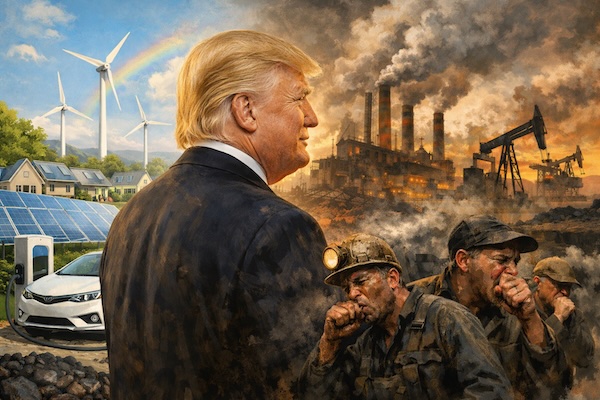
A self-serving political agenda is Trump's big reward for orders voiding a study finding that greenhouse gases endanger human health and promoting the coal and petroleum industries that have a limited future at best.
When Donald Trump signed executive orders nullifying the Environmental Protection Agency's foundational climate science and championing fossil fuel industries, the question that arose wasn't whether this would happen—his campaign promises had telegraphed these moves—but rather, why?
What possible advantage could a second-term president gain from actions that seemingly fly in the face of scientific consensus, global economic trends, and the stated preferences of younger generations who will inherit the consequences of today's environmental decisions?
The answer lies not in policy wisdom or economic foresight, but in the cold calculus of political self-interest and catering to a coalition built on grievance, nostalgia, and the deliberate rejection of expert consensus.
Trump's assault on climate science and his championing of declining industries represents a masterclass in symbolic politics—gestures designed not to solve problems but to signal loyalty to a base that has come to define itself partly through antagonism toward environmental regulation and the cultural forces associated with climate activism.
The EPA's endangerment finding, established during the Obama administration, provided the scientific and legal foundation for regulating greenhouse gas emissions under the Clean Air Act. This determination, backed by decades of peer-reviewed research and the overwhelming consensus of climate scientists worldwide, concluded that greenhouse gases pose a threat to public health and welfare.
Attempting to void or undermine this finding serves no practical purpose for American workers or businesses in the 21st-century economy. Global markets have already rendered their verdict on the future of energy: renewable sources are increasingly more cost-competitive than fossil fuels, and major corporations are making billion-dollar bets on decarbonization regardless of what Washington does.
So if not economic benefits, what explains Trump's actions? The first and most obvious answer is the consolidation of support from fossil fuel interests that have long funded conservative politics and remained among Trump's most reliable donors. Coal executives and petroleum company leaders have watched their political influence wane as the reality of climate change has become undeniable and as market forces have shifted investment toward cleaner energy sources.
Trump's orders throw them a political lifeline, even if that lifeline cannot stop the economic currents pulling their industries toward obsolescence. The signal is clear: this administration will use whatever power it possesses to slow their decline, regulatory science and technological evolution be damned.
The political benefits to Trump extend beyond campaign contributions. He has successfully cultivated an identity politics of anti-environmentalism among his core supporters. For many in his base, skepticism toward climate science has become a tribal marker, a way of distinguishing themselves from coastal elites, university professors, and the constellation of institutions associated with progressive politics.
Attacking the EPA and promoting coal and oil isn't really about energy policy—it's about thumbing one's nose at the people who shop at Whole Foods, drive Teslas, and lecture others about their carbon footprints.
This cultural dimension explains why Trump's rhetoric around these industries is steeped in nostalgia rather than forward-looking economic analysis. References to bringing back coal jobs and achieving energy dominance through petroleum extraction speak to a vision of American greatness that lives only in the past. These are industries that once powered American economic supremacy and provided stable, well-paying jobs to working-class communities.
That they can no longer fulfill this role in a globalized, technologically transformed economy is beside the point. The promise isn't really about jobs—it's about restoring a sense of dignity and centrality to rust-belt communities that feel left behind by economic and cultural change.
The political strategy is deeply cynical but highly effective: tell people in struggling regions that their decline isn't the inevitable result of technological change and global economic transformation, but rather the fault of environmental regulations and the effete liberals who champion them. Promise that removing these regulations will restore their communities to prosperity.
Never mind that automation has eliminated far more coal mining jobs than environmental regulation, or that natural gas has outcompeted coal primarily on price. The narrative serves its purpose by channeling economic anxiety into political support and cultural resentment.
Trump also gains from the confrontation itself. His presidency has thrived on conflict with institutions—the media, the intelligence community, the judiciary, and yes, scientific agencies. Each battle reinforces the narrative that he alone stands against a corrupt, elitist establishment that looks down on ordinary Americans.
By attacking the EPA's climate science, Trump creates another front in this ongoing culture war. When scientists, environmental groups, and Democratic officials protest, it only proves his point to supporters who have been conditioned by MAGA rhetoric to distrust these groups.
The international dimension offers another political angle. By rejecting climate science and promoting fossil fuels, Trump positions himself as standing up to global institutions and foreign powers who, in this telling, want to hamstring American industry with unfair environmental restrictions while they continue polluting freely.
Never mind that China is now the world's largest investor in renewable energy, or that European nations are outpacing the United States in clean energy innovation. The narrative of American energy dominance through fossil fuels appeals to nationalist sentiments and feeds hostility toward international cooperation.
There's also the simple pleasure of undoing Obama's legacy. Much of Trump's first term was characterized by a systematic effort to reverse his predecessor's achievements, and climate policy represented one of Obama's signature accomplishments.
The endangerment finding, the Clean Power Plan, fuel efficiency standards, membership in the Paris Agreement—these were the building blocks of Obama's climate agenda. Dismantling them serves the political purpose of erasing a rival's achievements while energizing supporters who viewed Obama's presidency with hostility.
Most cynically, promoting futureless industries allows Trump to make promises he'll never have to keep. The structural decline of coal employment won't reverse, and petroleum's long-term prospects dim with each passing year as alternatives become more viable. But Trump can promise revival, take symbolic actions, and then blame inevitable failures on obstruction by courts, bureaucrats, or future administrations. The gap between promise and reality doesn't matter if the promise itself generates political support in the present.
What Trump gains, then, is the financial support of industries fighting a rearguard action against economic obsolescence. He gains the cultural loyalty of communities that have been told their struggles stem from environmental overreach rather than inevitable economic transformation. He gains the satisfaction of antagonizing the experts, institutions, and political opponents he's built his brand opposing. And he gains the temporary political cover to avoid difficult conversations about how to actually help communities transition away from declining industries toward sustainable economic futures.
The tragedy is that all of this political calculation comes at the expense of both environmental protection and the very communities Trump claims to champion. Workers in coal country can only be helped by investment in education, infrastructure, and the industries that will actually provide jobs in coming decades. Americans are only protected by honest assessment of environmental risks and science-based policy responses.
But honest assessment and science-based policy don't generate the same emotional resonance as promises to restore a mythologized past and wage war against regulatory overreach. And so Trump's EPA orders, whatever their devastating long-term consequences, will likely achieve their true purpose: energizing a political base, rewarding loyal industries, and positioning their author as the champion of a version of America that exists only in memory and imagination.
Articles
- Department of Homeland Security Faces Partial Shutdown
- The Big Reward for Gutting the EPA and Promoting Futureless Industries
- US Withdraws List of Chinese Firms Linked to Military
- Election to Replace Greene Shows Trump Coattails Tattering
- Asia's 8 Most Romantic Places and the Great Love Stories Behind Them
Asian American Success Stories
- The 130 Most Inspiring Asian Americans of All Time
- 12 Most Brilliant Asian Americans
- Greatest Asian American War Heroes
- Asian American Digital Pioneers
- New Asian American Imagemakers
- Asian American Innovators
- The 20 Most Inspiring Asian Sports Stars
- 5 Most Daring Asian Americans
- Surprising Superstars
- TV’s Hottest Asians
- 100 Greatest Asian American Entrepreneurs
- Asian American Wonder Women
- Greatest Asian American Rags-to-Riches Stories
- Notable Asian American Professionals