

China's JUNO Neutrino Detector Advances Precision in Mass-Ordering Quest
By Reuters | 10 Jun, 2026
JUNO researchers unveil the first findings from the world's biggest, most advanced underground neutrino detector.
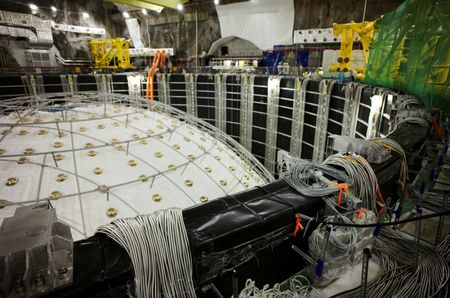
FILE PHOTO: A view of the soon-to-be-completed and sealed central detector at the Jiangmen Underground Neutrino Observatory (JUNO), during an organised media tour by the Chinese foreign ministry and the Chinese Academy of Sciences (CAS), in Kaiping, Guangdong province, China October 11, 2024. REUTERS/Ryan Woo/File Photo
Researchers working to solve the mysteries of neutrinos have unveiled the first scientific findings from a new underground facility in China - the most precise measurements yet of certain aspects of these ghostly subatomic particles.
The data comes from the JUNO - short for Jiangmen Underground Neutrino Observatory - facility using a particle detector built under about 2,130 feet (650 meters) of rock beneath a hill near the city of Kaiping in China's southern Guangdong province.
The scientists detailed their findings in a study, published on Wednesday in the journal Nature, based on data collected in the initial operating period after the detector's completion last year - its first roughly 59 days, from August 26 to November 2.
"This is important not only because the numbers themselves are useful for neutrino physics, but also because they demonstrate the performance of JUNO as a new large-scale detector," said Yifang Wang, a physicist at the Institute of High Energy Physics of the Chinese Academy of Sciences in Beijing and spokesperson for the JUNO Collaboration.
"This paper shows that the experiment has started from a solid foundation," Wang said.
Together with DUNE - short for the Deep Underground Neutrino Experiment - in the United States and the Hyper-Kamiokande experiment in Japan, JUNO is one of three large flagship projects expected to shape neutrino physics in the coming decades.
"Neutrinos are basic particles and are extremely abundant in the universe, but they remain among the least understood," Wang said.
Neutrinos can pass through anything, rarely interacting with matter. In fact, trillions of them travel through our bodies every second without us noticing.
Forged in places like the sun's core and exploding stars called supernovas, neutrinos come in three types, or "flavors," and can change from one to another, called oscillation, as they travel. The difference in mass, known as mass ordering, between neutrino types remains a key unanswered question.
"JUNO's central goal is to determine the neutrino mass ordering, meaning the ordering of the neutrino mass states. We know that neutrinos have mass, but we still do not know which mass state is the lightest and which is the heaviest," Wang said.
"This first result is not yet a determination of the mass ordering. Its value is that it validates the detector and the analysis with real data," Wang said.
JUNO measured two of the six fundamental neutrino oscillation parameters with the best precision so far, Wang said, about 1.6 times better than previously done.
Every type of particle of ordinary matter has a corresponding antiparticle with the same mass but opposite electric charge - positive, negative or neutral, as is the case with neutrinos. Thus, each neutrino has a corresponding antineutrino.
The JUNO experiment's chief approach in measuring neutrino oscillations is through observation of antineutrinos emanating from the Yangjiang and Taishan nuclear power plants, about 33 miles (52.5 km) from the detector. The two parameters involved the behavior of antineutrinos.
The JUNO detector is a large spherical tank filled with 20,000 tons of an organic liquid that emits light in the dark environment when particles including antineutrinos pass through it.
Neutrinos are elementary particles, meaning they are not built of anything smaller, making them one of the universe's fundamental building blocks. Because neutrinos are electrically neutral, they are undisturbed by even the strongest magnetic field. As neutrinos travel through space, they pass unimpeded through matter - stars, planets and anything else.
Scientists can trace them back to their source, and thus learn about some of the most energetic processes in the cosmos. They might be the key to understanding the origin of matter and its prevalence in the cosmos over its counterpart antimatter, the nature of dark matter and dark energy and the inner workings of supernovas.
Wang said JUNO will study neutrinos from the sun, Earth, the atmosphere and possibly a future supernova.
"Enormous numbers of neutrinos pass through the Earth every second, but only a tiny fraction interact. That is why experiments like JUNO need very large detectors, deep underground sites, careful shielding and long-term stable operation," Wang said.
JUNO, which cost more than $300 million, represents an international scientific collaboration. Wang said JUNO, DUNE and Hyper-Kamiokande are complementary efforts.
"They use different technologies and neutrino sources, so each brings a different perspective to some of the most important questions in neutrino physics. Together, they will provide a broader and more robust understanding of neutrino properties," Wang said.
(Reporting by Will Dunham; Editing by Daniel Wallis)
© 2026 by Asian Media Group Inc.
Recent Articles
- 'I Love the Inflation,' Trump Says of Prices Rising Amid Iran War
- China's JUNO Neutrino Detector Advances Precision in Mass-Ordering Quest
- Only 11% of Europeans View US as Ally, Survey Shows
- BYD Will Be World's Biggest Automaker in 5 Years Says Its Chairman
- US Consumer Prices Increase at Fastest Pace in 3 Years
- Traders Keep Bets on Fed Rate Hike by October
- Drone Risks Keep World Cup Security Planners Frantic
- Bill Gates to Face Congress in Probe of Epstein Case Handling
- Musk’s xAI, SpaceX Hit with Class Action over Data Center ‘Nuisance’
- Downed Chopper Prompts US to Launch New Strikes on Iran