

'I Love the Inflation,' Trump Says of Prices Rising Amid Iran War
By Reuters | 10 Jun, 2026
The latest data showing annualized inflation rising to 4.2% in May seemed to delight the man who single-handedly made it happen.
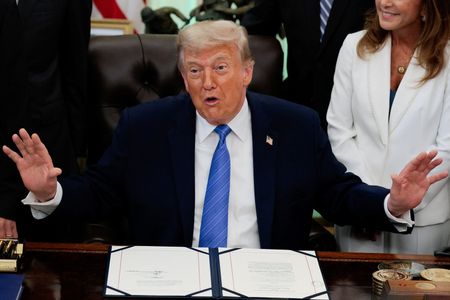
U.S. President Donald Trump speaks in the Oval Office as he signs the Secure America Act, at the White House in Washington, D.C., U.S., June 10, 2026. REUTERS/Evan Vucci
President Donald Trump on Wednesday appeared to embrace data showing inflation has risen more than 4%, telling reporters that he "loved" inflation and reiterating his belief that prices will fall as soon as the Iran war ends.
Asked about U.S. government data showing consumer inflation increased at its fastest pace in three years in May, and whether it could hobble his fellow Republicans just months ahead of November's midterm election, Trump said: "I love the inflation."
The president then explained how he greenlit a plan to secretly move oil tankers through the Strait of Hormuz over concerns of higher costs and increasing inflation. "It was worth it to me," Trump said about his calculus and calling the operation a success.
"When it's over, you will see oil drop to where it was before," Trump said of the larger war. "It's coming down. It's going to come down like a rock."
Trump has called the war on Iran a detour and framed it as a national security issue as Tehran's closure of the key shipping route has pushed up the cost of gasoline, fertilizer and other goods, contributing to inflation.
Higher prices could also keep the U.S. Federal Reserve from cutting interest rates, which could lower borrowing costs, which Trump has called for since returning to power last year.
Republicans are seeking to maintain control of the U.S. House of Representatives and the Senate but are concerned a consumer backlash could hand the reins to Democrats as the cost of living remains a top issue for voters.
Trump himself won the 2024 presidential election in large part because of his promise to lower inflation, but has since seen his approval rating, including on his handling of the cost of living, fall to the lowest level of his political career.
Efforts to reopen the Strait of Hormuz to tanker traffic to move goods have so far stalled, with industry executives and analysts warning that coming weeks could see another oil price shock severe enough to shake the broader financial markets.
Even if Trump and Tehran reach a deal soon, it is expected to take months to get supplies moving, with the disruptions expected through 2026. And while Americans may be more insulated from fuel shocks than other nations, ongoing higher energy prices could dent consumer spending over time.
Last month, Trump said Americans' financial struggles were not a factor as he pushes for a deal even while threatening renewed attacks on Iran: "I don’t think about Americans’ financial situation. I don’t think about anybody. I think about one thing: We cannot let Iran have a nuclear weapon."
(Reporting by Bo Erickson and Susan Heavey; editing by Scott Malone and Chizu Nomiyama )
© 2026 by Asian Media Group Inc.
Recent Articles
- 'I Love the Inflation,' Trump Says of Prices Rising Amid Iran War
- China's JUNO Neutrino Detector Advances Precision in Mass-Ordering Quest
- Only 11% of Europeans View US as Ally, Survey Shows
- BYD Will Be World's Biggest Automaker in 5 Years Says Its Chairman
- US Consumer Prices Increase at Fastest Pace in 3 Years
- Traders Keep Bets on Fed Rate Hike by October
- Drone Risks Keep World Cup Security Planners Frantic
- Bill Gates to Face Congress in Probe of Epstein Case Handling
- Musk’s xAI, SpaceX Hit with Class Action over Data Center ‘Nuisance’
- Downed Chopper Prompts US to Launch New Strikes on Iran