

How Chinese Is Italian Fashion?
By Ben Lee | 10 Jul, 2026
Chinese immigrants who have flocked to Italy's fashion design, manufacturing, marketing and retailing have brought about changes that keep Italian fashion competitive in the global market.
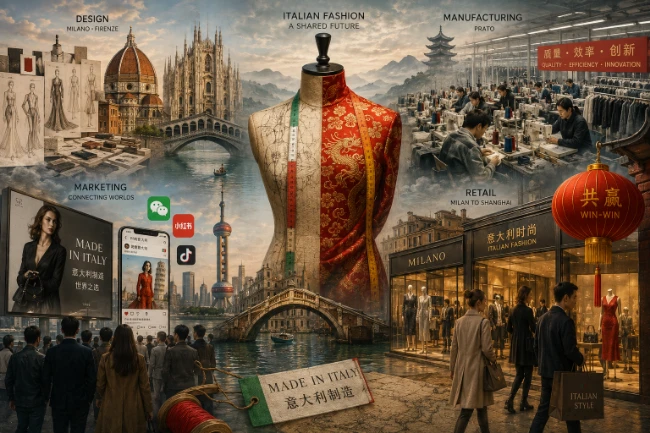
For generations, "Made in Italy" has conjured images of Florentine leather, Milanese tailoring, Venetian textiles and family-owned workshops where skills passed from parent to child over centuries produced some of the world's finest clothing and luxury goods. Italian fashion became synonymous with craftsmanship, elegance and meticulous attention to detail.
Yet behind many of the labels that still proudly proclaim Made in Italy stands a workforce that increasingly speaks Mandarin alongside Italian. Over the past four decades, Chinese immigrants have become an indispensable part of Italy's fashion ecosystem, not merely as sewing-machine operators but as entrepreneurs, logistics specialists, factory owners, wholesalers and, increasingly, designers and brand builders.
The story of Chinese involvement in Italian fashion is neither one of simple replacement nor one of exploitation alone. It's a story of globalization, entrepreneurship and adaptation. Chinese immigrants helped preserve portions of Italy's apparel industry that might otherwise have disappeared under pressure from lower-cost producers in Asia and Eastern Europe. At the same time, their rapid growth has generated debates over labor standards, immigration, identity and what it really means for a garment to be "Made in Italy."
Today, Italian fashion is still unmistakably Italian in its creative heritage. But its production, distribution and commercial energy have become far more Chinese than many consumers realize.
The Rise of Italy's Chinese Community
Large-scale Chinese immigration to Italy began during the 1980s. Most newcomers originated from Wenzhou in Zhejiang Province, an area famous throughout China for producing entrepreneurs with extraordinary commercial instincts.
Unlike many immigrant communities that initially sought factory jobs, Wenzhou migrants often viewed wage employment as merely the first step toward business ownership. They pooled family savings, shared housing, lent capital through informal networks and rapidly established workshops.
The city of Prato, near Florence in Tuscany, became their most important center. Historically one of Europe's leading textile districts, Prato already possessed extensive mills, dyeing facilities, machinery suppliers and fashion infrastructure. As many Italian-owned workshops struggled with rising labor costs and international competition, Chinese entrepreneurs found opportunities to purchase or lease facilities.
Within a generation, Prato became home to one of Europe's largest overseas Chinese communities.
Today thousands of Chinese-owned businesses operate there, making everything from fast-fashion garments to handbags, knitwear and accessories.
Saving an Industry Under Pressure
Beginning in the 1980s, Italian apparel manufacturers confronted intense competition from lower-cost producers across Asia.
Many traditional family businesses faced closure.
Chinese entrepreneurs entered precisely when flexibility had become essential.
Their workshops specialized in remarkably short production cycles.
Instead of requiring months to fulfill orders, many could complete small batches within days. They reorganized production schedules, operated longer hours and rapidly adjusted to changing consumer tastes.
This speed became invaluable as global fashion shifted toward shorter product cycles.
Fast-fashion retailers no longer wanted six-month lead times. They wanted factories capable of replenishing successful styles almost immediately.
Chinese-owned workshops helped Italian suppliers compete against manufacturers located thousands of miles away.
Rather than replacing Italian fashion, they often allowed it to remain geographically concentrated inside Italy.
The Fast Fashion Revolution
Italian luxury houses still rely upon artisans producing handbags, shoes and couture garments requiring extraordinary skill.
But below the luxury tier lies an enormous market for affordable fashion.
Chinese manufacturers transformed this segment.
Prato evolved into one of Europe's fastest fashion production hubs.
Design concepts could be translated into finished garments with astonishing speed.
Wholesalers purchased fabrics in the morning, approved samples by afternoon and shipped completed clothing within days.
This responsiveness became one of Italy's competitive advantages against countries whose lower wages were offset by much longer shipping times.
Being able to drive merchandise across Europe instead of waiting weeks for ocean freight proved increasingly valuable.
Beyond Sewing Machines
The stereotype of Chinese workers hunched over sewing machines misses the broader economic picture.
Many Chinese immigrants became vertically integrated entrepreneurs. Some import fabrics from Asia. Others own cutting operations. Many coordinate logistics. Some specialize in wholesale distribution. Others operate retail stores throughout Europe. Still others manufacture accessories including handbags, scarves, belts and footwear.
Entire supply chains emerged in which Chinese-owned firms collaborate with Italian textile mills, designers, machinery suppliers and transportation companies. The result resembles an ecosystem rather than a hierarchy. Italian creativity and Chinese entrepreneurial execution increasingly complement one another.
A New Generation of Designers
The first generation generally concentrated on manufacturing. Their children have pursued broader ambitions. Many grew up speaking both Mandarin and Italian. Educated in Italian schools, some attended prestigious design academies in Milan or Florence. Rather than remaining behind factory walls, younger Chinese Italians increasingly enter fashion design, branding, digital marketing and luxury retail.
Some launch independent labels reflecting both Chinese and Italian aesthetics. Others join established Italian brands in creative or management roles. Their bicultural perspective often provides valuable insight into Asian consumer preferences, now among the most important luxury markets in the world.
For Italian fashion companies seeking growth in China and Southeast Asia, employees who understand both cultures represent a significant competitive advantage.
Luxury's Chinese Connection
Even Italy's most prestigious luxury houses increasingly depend upon Chinese talent. Some Chinese-owned subcontractors produce components under strict quality standards. Others specialize in labor-intensive assembly work. Luxury companies maintain extensive quality control while outsourcing selected production stages.
At the same time, Chinese consumers have become among the world's largest buyers of Italian luxury goods. Employees with Chinese language skills, cultural understanding and commercial relationships have become increasingly valuable throughout luxury retail. Thus Chinese influence extends beyond production into marketing, merchandising and international expansion.
The Meaning of "Made in Italy"
One of the most contentious questions concerns labeling. European regulations generally allow products to qualify as "Made in Italy" if substantial transformation occurs within Italy. This means garments sewn in Italy from imported fabrics may legally carry Italian origin labels. Critics argue consumers often imagine every stage—from fabric weaving to finishing—occurred inside Italy.
Supporters counter that manufacturing has always relied upon global supply chains. Italian wool may come from Australia. Cotton may originate in Egypt. Silk may arrive from China. Leather chemicals may be imported from Germany. Modern manufacturing rarely confines every production step to one nation.
The debate therefore concerns perception as much as regulation.
What exactly are consumers purchasing when they buy Italian fashion? Craftsmanship? Geography? Heritage? Design? Or some combination of all four?
Challenges and Controversies
Chinese success has not been free from controversy. Authorities have periodically uncovered workshops violating labor regulations, tax rules or safety standards. Some factories have been criticized for excessively long working hours. Illegal immigration and underground employment have occasionally accompanied rapid business expansion.
These problems deserve serious attention. Yet they represent only part of the picture. Italian-owned businesses have also faced violations of labor and tax laws. The distinction often reflects business practices rather than ethnicity. Over time, increasing numbers of Chinese-owned firms have become fully compliant, investing in better facilities, advanced equipment and formal employment relationships. Many now compete on quality rather than merely cost.
The industry's gradual maturation mirrors the trajectory followed by immigrant business communities in many countries.
Economic Contributions
Chinese entrepreneurs contribute substantially to local economies. They lease vacant industrial buildings. Purchase machinery. Pay taxes. Employ thousands of workers. Support textile suppliers. Generate export revenue. Maintain logistics networks. And stimulate commercial districts that might otherwise have declined.
Prato provides perhaps the clearest example. Without Chinese investment, portions of its once-famous textile district might have experienced far steeper contraction. Instead, production continued—albeit in transformed form. Some Italian suppliers who initially viewed Chinese businesses as competitors eventually became important commercial partners. Machinery manufacturers, textile mills and service providers all benefited from continued manufacturing activity. Economic ecosystems often survive through adaptation rather than preservation.
Italian Style Remains Italian
Despite these profound changes, few would argue that Chinese immigrants invented Italian fashion. The world's admiration for Italian design rests upon centuries of accumulated artistic traditions. The tailoring of Naples. The leather craftsmanship of Florence. The textile innovation of Como. The fashion houses of Milan. These remain deeply rooted in Italian history.
Chinese participation strengthened the production system surrounding that creative heritage. One might compare the relationship to Hollywood. American filmmaking depends upon talented immigrants from around the world, yet audiences still regard Hollywood as an American industry. Similarly, Italian fashion increasingly represents a multinational collaboration operating within an unmistakably Italian cultural framework.
Globalization in Both Directions
The relationship has become increasingly reciprocal. While Chinese immigrants transformed Italy's fashion industry, Italy profoundly shaped the immigrants themselves. Second-generation Chinese Italians often identify strongly with both cultures. Many speak regional Italian dialects. They support Italian football clubs. They attend Italian universities. They marry across ethnic lines more frequently than their parents.
At the same time, they maintain family ties to China while bringing Chinese tastes and business relationships into European fashion. This cultural hybridity increasingly defines global industries. Rather than replacing national identities, globalization often produces layered identities capable of navigating multiple societies simultaneously.
Keeping Italy Competitive
Perhaps the greatest contribution Chinese immigrants made was preserving manufacturing capacity inside Italy. Without flexible workshops capable of serving rapidly changing markets, much more production might have relocated permanently overseas. Instead, Italy retained a substantial domestic manufacturing base.
That proximity continues to benefit luxury houses requiring rapid prototyping, high quality and close collaboration between designers and manufacturers. Even brands producing globally still rely upon Italian expertise during crucial stages of product development. Chinese-owned firms became part of the infrastructure that supports this broader ecosystem.
The Future of Italian Fashion
The next chapter will likely feature greater automation, sustainability and digital integration. Factories increasingly employ computer-controlled cutting machines, robotic material handling and AI-assisted production planning. Chinese entrepreneurs have generally shown considerable willingness to invest in new technologies.
Meanwhile, younger generations place greater emphasis on branding than contract manufacturing. Instead of simply producing garments for others, many aspire to create internationally recognized fashion labels of their own. Some combine minimalist Italian tailoring with Chinese artistic influences. Others develop brands aimed specifically at Asian luxury consumers. These trends suggest that Chinese participation in Italian fashion will become even more visible at the creative level.
The distinction between "Italian" and "Chinese" fashion may continue to blur—not because either identity disappears, but because successful brands increasingly draw strength from both traditions.
A Shared Success Story
The phrase "Made in Italy" still carries extraordinary prestige, and deservedly so. Italian designers, artisans and luxury houses remain among the world's most influential tastemakers. But preserving that position required adaptation.
Chinese immigrants supplied much of the entrepreneurial energy, manufacturing flexibility and commercial resilience that helped Italy navigate decades of globalization. They revitalized aging industrial districts, accelerated production cycles, expanded wholesale networks and increasingly contributed creative talent of their own.
The result is an industry that remains unmistakably Italian in its artistic DNA while becoming more international in its workforce, ownership and commercial reach. So how Chinese is Italian fashion?
Far more Chinese than most shoppers imagine—but still profoundly Italian where it matters most: in the creative vision, craftsmanship and cultural heritage that continue to define one of the world's greatest fashion traditions. The modern success of Italian fashion is not the triumph of one culture over another. It is the product of two entrepreneurial traditions discovering that, together, they could keep one of Europe's most celebrated industries competitive in an increasingly interconnected world.
© 2026 by Asian Media Group Inc.
Recent Articles
- Chey Tae-won's Risky Bet Pays off as SK Hynix Debuts in New York
- Volkswagen Deliveries Suffer Biggest Drop Since 2022 on China Slump
- Delta Signals Fare Hikes Will Stay as Resilient Demand Cushions Fuel-Cost Hit
- Nvidia Supplier King Yuan Electronics to Invest up to $1.4 Billion in US Facility
- Tanker Traffic Slows in Strait of Hormuz After US and Iran Clashes
- Shein Finally Wins China's Approval for Hong Kong IPO on 3rd Attempt
- Inside the US Race for Drone Delivery Dominance
- How Chinese Is Italian Fashion?
- Global EV Demand Rises Again as Europe Offsets China, US Weakness
- OpenAI Unveils Long-Awaited "Super App" in Answer to Anthropic's Claude CoWork