

Inside the US Race for Drone Delivery Dominance
By Reuters | 10 Jul, 2026
A Trump executive order in June 2025 prompted the Federal Aviation Administration to proposed new rules to speed the deployment of drones as the US sees itself locked in a battle with China for drone dominance.
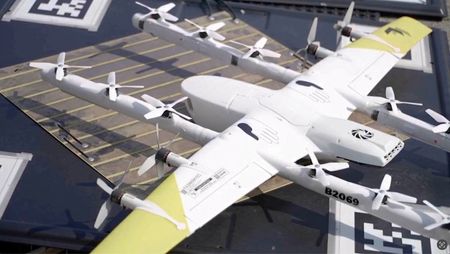
A drone used for Walmart deliveries in Ellenwood, Georgia, United States in Ellenwood, Georgia, U.S., July 1, 2026, in this screengrab from video. REUTERS/Jayla Whitfield-Anderson
Engineer Beth Flippo uprooted her family in 2021, trading New Jersey for the rambling fields of Ohio, where she had been tapped to run a pilot program delivering groceries via drone for Kroger.
It lasted just eight months before both parties agreed to suspend it. "We couldn't make any money," said Flippo, head of drone company Dexa.
Success would have meant placing workers around town to watch the drones, as U.S. federal rules prohibited flying them outside human sight. “It just couldn’t scale," she said.
Such hurdles may soon be a thing of the past. Spurred by an executive order by President Donald Trump's administration in June 2025, the Federal Aviation Administration has proposed new rules to speed the deployment of drones.
It comes as American leaders see the nation as locked in a battle with China for drone dominance. “America – not China – will lead the way in this exciting new technology,” U.S. Transportation Secretary Sean Duffy said in a statement in August.
Dexa is in active talks with Kroger to revive its mothballed drone program, Flippo says. A Kroger spokeswoman declined to confirm the discussions. Dexa eventually received an FAA waiver to fly outside the visual line of sight -- but the process took four years.
If adopted, the new FAA rules could significantly shorten that horizon -- and open the floodgates on a movement that's already gaining momentum.
Researchers at PwC in 2024 estimated that the U.S. drone market will grow 65% a year through 2034. Globally, drone deliveries will spike from about 13 million this year to more than 800 million in 2034, PwC forecast.
For now, the market is relatively small - a few billion dollars globally, according to a range of estimates. But U.S. retail behemoths Walmart and Amazon, which began their drone programs in 2021 and 2022, respectively, are actively scaling networks. Food industry players like Papa John's, Wonder, and DoorDash are building out more nascent programs, having partnered in recent years with drone companies able to operate through waivers.
"We’re at a commercial inflection point,” said Heather Rivera, chief business officer at Wing, Alphabet's drone division, which boasts Walmart as its biggest client.
Rivera was hired less than a year ago to forge more commercial links with retailers and restaurants -- the first position of its kind at the 12-year-old drone-maker and operator.
At Walmart, which also partners with drone provider Zipline, drone delivery is mainly used for "last-minute, urgent, convenience-driven items," said Mike Walden, the retailer's senior vice president of fulfillment innovation. That means things like allergy meds, cat food, and the mustard the barbecue host suddenly realizes he forgot.
The Walmart app tells shoppers if their purchase is drone-eligible at the outset. If a shopper selects drone delivery, the app tracks their cart, to make sure their order fits within the drone's weight limits, Walden said. With drone technology still relatively new, weight capacities are limited. At Walmart, the max capacity, or payload, is about 3 to 8 pounds, depending on the drone, Walden said.
Walmart is "inching toward 2 million" drone deliveries, said Walden. But the large majority have come this year, as the program rapidly grows. Walmart has drones at 70 stores, a tiny fraction of its roughly 4,600 U.S. locations, but aims to surpass 270 by the end of next year, Walden said.
Amazon, which this week opened its 10th U.S. drone delivery network in Baton Rouge, Louisiana, says its drones deliver in less than half an hour.
Challenges remain - several communities have flagged concerns about noise and privacy - but the potential cost benefits are alluring. The PwC researchers estimated per-delivery costs could fall to as low as $2 by 2034, much lower than traditional delivery.
Neither Walmart nor Amazon would comment on the cost per delivery. "But if it wasn't competitive, we wouldn't be continuing to invest in the technology," said Amazon's global head of drone expansion, Matt McCardle.
Most U.S. drone operators and retailers are targeting suburbs, where spacious yards, congested road traffic, and population density make quick, air-based delivery attractive. Speed is a key draw: Walmart claims to have achieved a drone delivery in under five minutes, and says drones are generally a bit faster than ground deliveries.
Rivera said she recently got ice cream delivered via drone - still cold.
“Everyone is trying to scale as fast as they can,” said Amit Regev of Tel Aviv-based Flytrex, which in April announced a partnership with Little Caesars to deliver pizzas.
'EXPONENTIAL GROWTH'
The FAA's proposal, not yet finalized, would allow certified drone operators to fly beyond the visual line of sight, eliminating the need for a long, and sometimes costly, waiver process.
That could catalyze "massive, exponential growth of the space over the next few years,” said Andreas Raptopoulous, CEO of California-based drone maker Matternet.
It comes as China's "low altitude economy," defined as aerial commerce below 3,000 meters, is forecast to grow to more than 2 trillion yuan ($280 billion) by 2030, up from 1.5 trillion yuan in 2025, according to estimates from the Chinese Academy of Sciences, Peking University, and China's Civil Aviation Administration. Drone deliveries are concentrated in cities like Shenzhen and Guangzhou.
E-commerce giant JD Logistics, which has tested drone delivery networks in Jiangsu, Shaanxi, and Sichuan, has said in recent online statements that its drones can reduce shipping times for rural customers by up to 70%.
$25 AN HOUR
Absent the line-of-sight restriction, drone delivery becomes a low-manpower operation, Flippo said. One controller, making around $25 an hour, can watch 40 drones at once on a screen - roughly 160 deliveries an hour, she said. That's a fraction of what it costs to deploy a fleet of drivers.
Dexa has forged smaller partnerships with food delivery services like Wonder - though, Flippo admits, competing against heavyweights like Alphabet "feels like fighting Goliath."
Testing by Walmart and rivals is also accelerating technological progress.
"With each cycle, the hardware, battery, range and reliability all improve," said Marios Savvides, a professor at Carnegie Mellon University's College of Engineering. Technology matures "in the field - not in the lab."
(Reporting by Waylon Cunningham and Nicholas Brown, editing by Lisa Jucca)
© 2026 by Asian Media Group Inc.
Recent Articles
- Chey Tae-won's Risky Bet Pays off as SK Hynix Debuts in New York
- Volkswagen Deliveries Suffer Biggest Drop Since 2022 on China Slump
- Delta Signals Fare Hikes Will Stay as Resilient Demand Cushions Fuel-Cost Hit
- Nvidia Supplier King Yuan Electronics to Invest up to $1.4 Billion in US Facility
- Tanker Traffic Slows in Strait of Hormuz After US and Iran Clashes
- Shein Finally Wins China's Approval for Hong Kong IPO on 3rd Attempt
- Inside the US Race for Drone Delivery Dominance
- How Chinese Is Italian Fashion?
- Global EV Demand Rises Again as Europe Offsets China, US Weakness
- OpenAI Unveils Long-Awaited "Super App" in Answer to Anthropic's Claude CoWork