

Chetan Nayak Fails to Quell Skeptics Even with Majorana 2 Quantum Chip
By JL Zhang | 13 Jul, 2026
2,000-fold more stability in the Microsoft chip's topological qubit fails to satisfy those who question the quantum nature of its physics.
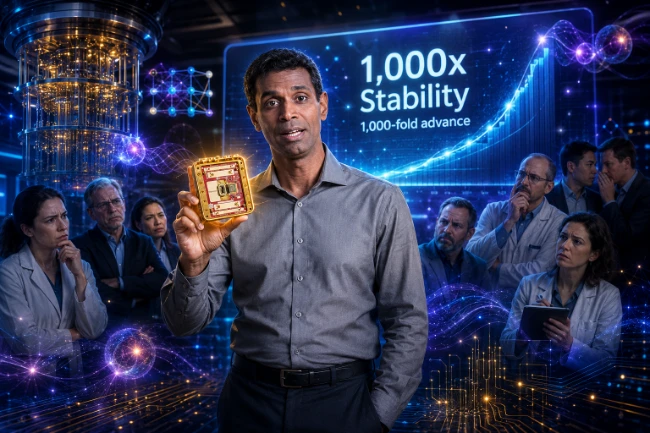
Chetan Nayak and Microsoft have doubled down on one of the riskiest bets in quantum computing: that elusive Majorana-based topological qubits can leapfrog the more conventional approaches pursued by IBM, Google, Quantinuum and IonQ.
The June 2026 release of Microsoft’s Majorana 2 chip was meant to show that the bet is finally paying off. The company said the upgraded chip’s qubits are more than 1,000 times more reliable than those in the prior generation, with a mean lifetime of 20 seconds and some instances lasting close to a minute. Measured against earlier 1-to-12-millisecond lifetimes, the improvement can reasonably be framed as roughly 2,000-fold from a midpoint comparison, and far more if measured from the low end. Microsoft also said the progress lets it target a scalable quantum computer by 2029, cutting its earlier timeline in half.
A Spectacular Claim Lands in a Skeptical Field
That would be stunning if the physics is what Microsoft says it is. The entire attraction of topological quantum computing is that information can be stored in a form naturally protected from many ordinary sources of noise. In theory, that means far fewer errors, far less correction overhead and a cleaner path to machines big enough to solve valuable problems in chemistry, materials science, logistics and cryptography.
Nayak, a Microsoft technical fellow and corporate vice president of quantum hardware, has spent years making the case that topological qubits are not a scientific curiosity but the shortest route to practical quantum computing.
Majorana 2 Changes Materials, Not the Debate
The most concrete change in Majorana 2 is the materials stack. Microsoft replaced the aluminum used in Majorana 1 with lead and changed the semiconductor active region to a combination of indium arsenide and indium arsenide antimonide. The company says those changes more than doubled the topological gap, the energy barrier that is supposed to help protect the qubit from environmental noise and accidental state changes. Its technical paper reports a 20-second characteristic parity-switching time in an InAs-Pb tetron device, with occasional minute-scale lifetimes, while operations are supposed to occur on microsecond time scales.
As an engineering result, that’s impressive. Better materials, longer parity lifetimes and faster tuning methods are exactly the kinds of progress Microsoft needed to show after years of skepticism. The company is also wrapping the achievement into a broader story about agentic AI, saying its Microsoft Discovery tools helped manage fabrication, measurements and troubleshooting. In Microsoft’s telling, Majorana 2 is not just a better chip. It’s a sign that AI-assisted science is accelerating the path toward a commercially valuable quantum computer.
But the chip’s critics aren’t mainly arguing that Microsoft failed to improve a device metric. Their objection remains more fundamental—that Microsoft still hasn’t conclusively shown that the effect it is measuring comes from the topological Majorana physics needed for a real topological qubit.
That distinction is crucial. A long-lived signal in a complicated superconducting nanowire is useful only if it reflects the desired quantum state rather than disorder, quantum dots, trivial bound states or some other ordinary condensed-matter behavior that mimics the signature Microsoft wants to see.
Better Lifetimes Don't Prove Majoranas
Science News captured the reaction neatly: Microsoft’s upgraded chip gives hope “for those who believe the company’s claims,” but the upgrade hasn’t convinced harsh critics of the earlier work. The reason is that Microsoft’s device depends on Majorana zero modes, exotic collective excitations that are supposed to form at the ends of superconducting nanowires. Those paired Majoranas would store information in a way that resists local disturbances. But skeptics have long warned that other effects in nanowires can look Majorana-like without being useful for topological quantum computing.
Nature’s coverage made the same point in more restrained language, calling Majorana 2 an upgraded version of the “highly controversial” Majorana 1 chip and noting that some researchers remain skeptical of Microsoft’s claims. That’s a sharp contrast with the triumphant tone of the announcement. Microsoft sees a roadmap speeding up. Critics see an old evidentiary gap dressed in new materials and bigger numbers.
The core scientific issue is not whether Nayak’s group has built an elegant device. It plainly has. The issue is whether the device has crossed the threshold from sophisticated nanowire physics into validated topological-qubit physics. F or many outsiders, the necessary hallmarks would include independent replication, transparent raw-data analysis, clearer exclusion of trivial explanations and eventually a convincing demonstration of non-Abelian behavior, such as braiding or a comparable topological operation. Majorana 2 doesn’t yet provide those field-settling demonstrations.
A Peer-Reviewed Critique Raises the Temperature
The skepticism intensified because Majorana 2 arrived just before a new peer-reviewed critique in Nature challenged the foundations of Microsoft’s earlier Majorana 1 claims. Henry Legg, a quantum physicist at the University of St Andrews, argued that Microsoft’s Topological Gap Protocol, the software method used to identify promising device regions, could produce inconsistent results depending on measurement choices. According to the St Andrews summary, Legg’s critique alleged coding errors, a flawed tune-up protocol, selective presentation of favorable outcomes and raw conductance data that looked more like disorder and quantum-dot behavior than a clean topological gap.
Reuters reported that the critique challenged a February 2025 paper central to Microsoft’s subsequent quantum efforts. Legg argued that a broader dataset Microsoft released, but did not include in the original paper, looked like random noise rather than clear evidence of the claimed gap. Microsoft disputed the critique and said the software is a practical tuning tool it uses on chips now performing quantum operations. Nayak defended the program with a vivid analogy: debating whether flight is possible while standing next to an airplane.
That analogy captures Microsoft’s frustration. rom its perspective, the chips are improving, the measurements are getting stronger, DARPA has continued evaluating its roadmap and the devices are doing real quantum operations. But to critics, the airplane analogy begs the question. They don’t agree that what’s sitting on the runway is an airplane. They see something noisy, fragile and fascinating, but not yet proven to be the topological machine Microsoft says it is.
A Long History Makes the Burden Heavier
Microsoft’s problem isn't just the current critique. It’s the history of the Majorana hunt. The field has seen bold claims before, including Microsoft-supported work that later had to be retracted. Reuters noted that two previous Microsoft-backed papers were retracted from Nature, while editors flagged possible problems in two others. Microsoft has said those retracted papers were done outside its labs and that it did not review the data before publication. Still, the history has made physicists more cautious about any claim that Majorana zero modes have finally been tamed.
That history puts Nayak in a difficult but not unfamiliar position. He is both a serious physicist and the public face of a corporate moonshot. Microsoft’s rivals can build on better-established qubit platforms such as superconducting circuits, trapped ions or neutral atoms, even if those approaches face their own scaling nightmares. Nayak’s topological path promises a cleaner future, but only after crossing a more treacherous evidentiary canyon.
A Strong Engineering Case but No Scientific Consensus
The fairest verdict is that Majorana 2 strengthens Microsoft’s engineering story while leaving its scientific story under heavy challenge. The longer parity lifetime is a meaningful result. The lead-based materials stack may well be a real advance. The 2029 roadmap may even prove less fanciful than critics assume if the company can keep improving device quality.
But the release has also drawn more skepticism because it makes the stakes clearer. Microsoft is no longer merely arguing that Majorana-based qubits might someday work. It is telling customers, investors, researchers and government evaluators that the technology is advancing fast enough to support a practical machine within years. That transforms a disputed physics claim into a major strategic claim.
For Nayak, Majorana 2 is both vindication and vulnerability. It gives supporters a spectacular number to point to: 20 seconds instead of milliseconds. It gives skeptics a larger target: a sweeping quantum-computing roadmap resting on a still-contested interpretation of difficult nanowire experiments. Until Microsoft can show not just long-lived signals but unmistakable topological behavior, the Majorana 2 chip will remain what Majorana 1 was before it: one of the most intriguing, ambitious and disputed bets in the race to build a useful quantum computer.
© 2026 by Asian Media Group Inc.
Recent Articles
- IBM Warns AI Boom Is Squeezing Software Budgets; Sending Shares Down
- Two Utah National Monuments Fall to Trump Anti-Green Drive
- 72% of Americans Disagree with Trump on Refugees
- June CPI Not As Hot As Feared, Soothing Markets
- CXMT IPO Puts It on Trajectory toward Global DRAM Leaders
- China's June Trade Tops Forecasts Buoyed by AI Boom
- China Purges 3rd Politburo Member in Deepening Anti-Graft Drive
- Nvidia Halves Asia AI Chip Customer List
- Chetan Nayak Fails to Quell Skeptics Even with Majorana 2 Quantum Chip
- The Brothers Who Inspired the Term “Siamese Twins”