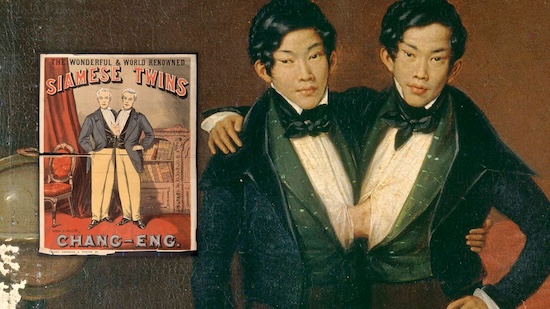

The Brothers Who Inspired the Term “Siamese Twins”
By Kelli Luu | 14 Jul, 2026
Over 200 years ago, two conjoined twin brothers from Siam forever changed how people understood their condition.
© 2026 by Asian Media Group Inc.
Most people have heard the phrase “Siamese twins”, but did you know its origins come from a story of two conjoined brothers from Thailand?
Chang and Eng Bunker were born as conjoined twin brothers on May 11, 1811 to a Chinese family in Siam, which is now known as Thailand. They were joined at the chest by a band of tissue that connected to their livers and the brothers became famous during the 19th century, giving rise to the phrase “Siamese twins”. While the term is considered synonymous for conjoined twins all over the world, medical professionals stick with “conjoined twins” due to accuracy and respectfulness.
When Chang and Eng were first born, there was very little known information about conjoined twins and many people viewed them with fear and superstition, while doctors saw a rare opportunity to learn more. Even with all the public attention they received, Chang and Eng still grew up living ordinary lives in Siam, helping their family fish and raise ducks, until everything changed in 1829 when a Scottish merchant Robert Hunter learned about the twins and made an effort to capitalize.
Chang and Eng were only seventeen years old when they agreed to travel West with Hunter and his crew, arriving in Boston in August 1829. The agreement? The twins would be "exhibited to the public”. Their arrival was reported in newspapers and crowds would flock to see the brothers, just out of pure curiosity. After seeing Chang and Eng, their intelligence and athleticness stood out completely and audiences were fascinated by their capability of living active and independent lives despite being connected physically.
The brothers toured throughout the U.S. and Europe, eventually leaving their manager and taking control of their own exhibitions. After years of traveling, they retired from the exhibition life and settled in North Carolina where they became naturalized U.S. citizens, adopted the surname Bunker, and purchased multiple farms and plots of land. In 1843, Chang and Eng married sisters Adelaide and Sarah Yates and fathered 21 children together, sticking to alternating schedules so the brothers could spend time with both families.
Chang and Eng found success in America and remained conjoined until their deaths in January 1874 at the age of 62 when Chang passed away from a stroke and Eng just a few hours later. Their autopsy would later lead to one of the earliest and most important medical studies regarding conjoined twins and has helped advance doctors’ understanding of the condition, cementing the remarkable story of Chang and Eng Bunker as an enduring part of history.
Recent Articles
- IBM Warns AI Boom Is Squeezing Software Budgets; Sending Shares Down
- Two Utah National Monuments Fall to Trump Anti-Green Drive
- 72% of Americans Disagree with Trump on Refugees
- June CPI Not As Hot As Feared, Soothing Markets
- CXMT IPO Puts It on Trajectory toward Global DRAM Leaders
- China's June Trade Tops Forecasts Buoyed by AI Boom
- China Purges 3rd Politburo Member in Deepening Anti-Graft Drive
- Nvidia Halves Asia AI Chip Customer List
- Chetan Nayak Fails to Quell Skeptics Even with Majorana 2 Quantum Chip
- The Brothers Who Inspired the Term “Siamese Twins”