

How Trump Turbo-Charged China's Quest for Global Primacy
By Tom Kagy | 12 Jul, 2026
Policies purportedly intended to promote US dominance have instead given China myriad opportunities to show its centrality and stability in global commerce.
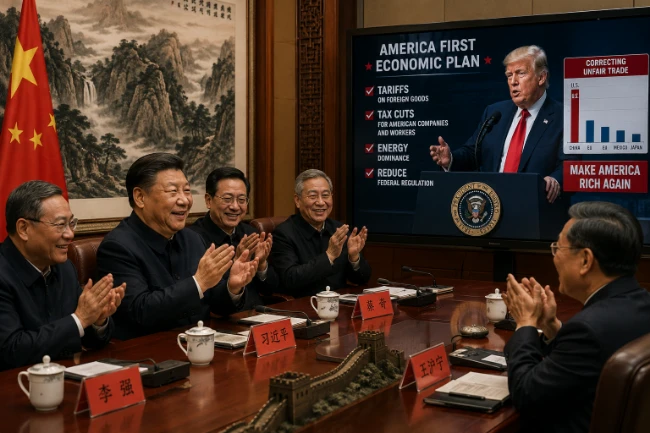
If China had wanted to create a "Manchurian Candidate" to help its quest for global primacy, he might look a lot like Donald Trump—a demagogue rallying the American heartland to embrace backward-looking policies with simplistic working-class appeal—isolationist, protectionist and frankly racist—that weaken the United States while strengthening China's influence around the world.
Trump returned to the White House in January 2025 on a pledge to overhaul the global trading system to restore American dominance, bring factories roaring back, and finally force Beijing to heel. Eighteen months later, the scoreboard tells a different story. China posted a record trade surplus of roughly $1.2 trillion in 2025. Its exports surged more than 20 percent year-over-year in early 2026.
Global surveys find publics on every continent concluding that Chinese influence is rising while American influence recedes. In capitals from Brasília to Seoul, governments that once anchored their economic strategies to Washington are hedging toward Beijing. The great irony of the second Trump term is that a project explicitly designed to contain China has actually accelerated its long-sought quest for global primacy.
The Tariff Wall That Redirected the World's Trade
The centerpiece of the administration's strategy—sweeping tariffs announced with theatrical flourish on "Liberation Day" in April 2025—was supposed to liberate the United States from dependence on foreign goods. Instead, it liberated much of the world from dependence on the United States. A year after the announcement, global trade continued to expand and set records; it simply rerouted around America. Supply chains that once terminated in Los Angeles and Savannah now flow through Southeast Asia, Latin America, and the Gulf, with China sitting at the center of the new web.
Beijing responded to lost American market share not by capitulating but by diversifying. Chinese exporters opened new markets across the Global South at a pace few predicted, and countries such as Malaysia, Indonesia, and Thailand—lacking the fiscal muscle to build competing industrial ecosystems—effectively ceded manufacturing supply chains to China by default.
Meanwhile, American exporters absorbed the blowback. China essentially stopped buying US goods in the spring of 2025; American shipments to the world's third-largest importing economy collapsed to levels unseen since the global financial crisis. Soybean exports fell to their lowest level since the first trade war, and Beijing locked in alternative suppliers in Brazil and Argentina—relationships that will outlast any truce.
Washington's answer was another multibillion-dollar round of farm subsidies, a tacit admission that the policy was inflicting the very dependence and dysfunction it was meant to cure.
A Masterclass in Leverage
If the tariff war revealed anything, it is that economic warfare favors the side that controls chokepoints, and China spent two decades acquiring them. When Washington escalated, Beijing reached for its rare-earth card—export controls on the minerals and processing technologies without which American defense contractors, automakers, and chipmakers cannot function. The move forced the administration to the table and produced a truce largely on Beijing's terms. More important than the immediate concessions was the demonstration effect: the world watched China discipline the United States with a single export-control notice.
Beijing absorbed the lesson and is institutionalizing it. Chinese strategists now openly describe supply-chain dominance in rare earths, battery materials, and legacy semiconductors as durable leverage—useful not only against Washington but against Japan, Australia, or any coalition that might mobilize over Taiwan. American efforts to build alternatives have moved slowly, hampered by permitting delays, environmental setbacks, and financing gaps. The tariff war did not break China's chokehold; it advertised it.
Alienating the Coalition That Might Have Contained China
Perhaps the most self-defeating feature of the America First trade agenda has been its indiscriminate targeting of friends. A serious strategy for competing with China would have assembled the world's democracies and market economies—collectively representing the majority of global GDP—into a common front on Chinese overcapacity, subsidies, and coercion. Instead, allies got tariff threats, annexation taunts, and public humiliation.
Canada was hit with escalating tariffs and rhetoric about becoming the fifty-first state. Brazil absorbed a 40 percent tariff and responded by fast-tracking trade agreements with Europe and courting the Gulf and India. South Korea's president made China his first overseas destination of 2026. Even Mexico, while erecting its own barriers to Chinese goods to preserve its US access, has done so under duress rather than conviction.
The result is a world busily constructing trade architecture that excludes the United States. Mercosur deepened ties with Europe and signed a long-stalled agreement with the European Free Trade Association. Asian economies knitted themselves more tightly into China-centered production networks. Canada's prime minister, whose predecessors had aligned with Washington against Beijing at real cost, traveled to Beijing to meet Xi in January 2026—a thaw that would have been unthinkable had loyalty to the United States still paid dividends.
Every new agreement signed without Washington is a small brick in the alternative order Beijing has spent years promoting—and Washington supplied the mortar.
The Soft-Power Vacuum
While the trade war grabbed headlines, a quieter transfer of influence unfolded in the machinery of American engagement with the world. The dismantling of USAID, the gutting of the State Department, the strangling of Voice of America, and restrictive visa policies amounted to what one former NATO official called soft-power suicide. The late Joseph Nye, who coined the term, warned before his death that China stood ready to fill the vacuum Trump was creating.
The polling confirms the shift. A 2025 Pew survey across two dozen countries found favorable views of the United States plunging—by twenty points in Canada alone—while China made gains. A European Council on Foreign Relations survey of 26,000 people across 21 countries found majorities almost everywhere expecting China to grow more powerful over the coming decade; its authors concluded that Trump was, in effect, "making China great again." In Latin America, respondents in every major country surveyed now prefer China to the United States as an economic partner. Brand Finance's 2026 soft-power index recorded China as the only top-ten nation to gain ground, narrowing its gap with the United States to the slimmest margin ever measured.
Beijing as the Champion of Stability
China has needed to do remarkably little to harvest these gains. Its diplomats simply show up, sign agreements, and repeat a message tailor-made for the moment: China is predictable; America is not. Xi Jinping casts Beijing as the defender of free trade and multilateralism against American protectionism—an audacious rebranding for the world's most heavily subsidized mercantilist economy, but one that lands because the contrast is real.
While US trade policy lurched through emergency declarations, 90-day pauses, threatened 100 percent surcharges, and Supreme Court reversals—the justices struck down the administration's primary tariff authority in February 2026, and a trade court invalidated its replacement months later—China's leadership executed the same patient plan it has followed for decades. Businesses and governments planning ten years ahead noticed which superpower offers continuity.
The costs of that volatility have also accumulated at home, further denting the American model's appeal. Studies consistently show the tariffs being paid overwhelmingly by US consumers and businesses rather than foreign exporters. Consumer sentiment hit a record low in the spring of 2026, and the dollar sank to a four-year trough—hardly the portrait of resurgent dominance the policy promised, and exactly the tableau Beijing's propagandists needed.
In emerging markets, meanwhile, China pairs its stability message with concessional financing, infrastructure construction, and increasingly AI technology packages bundled with easy credit and long repayment timelines—terms priced for cash-strapped governments—while comparable American offerings remain scarce, expensive, and reliant on private capital.
A Boon, Not a Blank Check
None of this means China's triumph is assured or that it has suddenly become a force for global good. Beijing hasn't made a serious effort to expand its foreign-assistance budget to replace American aid. Even a global public that admires Chinese commerce still distrusts Chinese leadership. Two-thirds of respondents across 25 countries express no confidence in Xi to do the right thing in world affairs.
And, worst of all, China's own coercive instincts, on display in its confrontation with Japan and its South China Sea pressure campaigns, regularly undercut its charm offensive. Its economy carries deep structural problems, from property-sector debt to deflationary pressure, that no trade surplus can fully mask. Much has to change before Beijing can actually lay claim to having displaced the United States.
But China didn't need to win the world's affection; it needed only to look steadier than a United States actively torching its own greatest advantages. The tariff wars validated Beijing's chokepoint strategy, scattered the coalition that might have constrained it, redirected global commerce through Chinese networks, and handed Xi the stability narrative he could never have manufactured alone. Chinese scholars now speak openly of a "tipping point" in relative strength and a "new window of opportunity." They didn't do much to make the shift happen—Trump did.
© 2026 by Asian Media Group Inc.
Recent Articles
- Open or Closed? Depends on Who You Ask
- China Temporarily Bans Helium Exports as Mideast Tensions Flare
- China Evacuates Nearly 2 Million as Typhoon Bavi Nears
- Ro Khanna Detained by Israeli Settlers During West Bank Visit
- Bedtime Story: The Moon Princess in the Bamboo Grove
- SK Hynix Sees Memory Shortage Worsening in 2027, Persisting for Years
- Three College Standouts to Watch in the MLB Draft
- Why India Has Never Played in a World Cup
- How Trump Turbo-Charged China's Quest for Global Primacy
- Chey Tae-won's Risky Bet Pays off as SK Hynix Debuts in New York