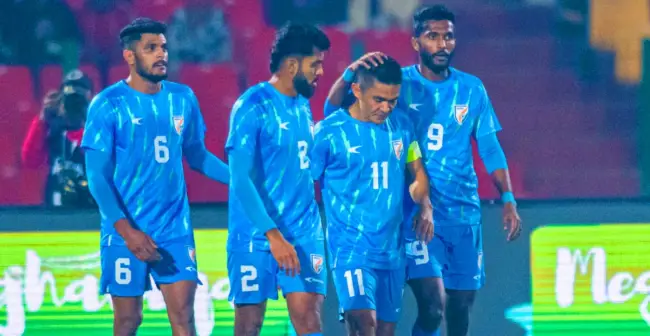

Why India Has Never Played in a World Cup
By James Moreau | 11 Jul, 2026
Despite a population of 1.4 billion, India remains absent from the World Cup due to fractured development, rigid academics, and restrictive nationality laws.
© 2026 by Asian Media Group Inc.
It is a profound demographic paradox: within a population of 1.4 billion people, the Indian men’s national football team has never once stepped onto a World Cup pitch. While the nation’s cricketers enjoy religion-like worship, Indian soccer remains mired in a state of perpetual underachievement, leaving observers to wonder – how can the world’s most populous country remain completely invisible on the world’s largest sporting stage?
In 1950, India earned a spot at the World Cup in Brazil by default, after the other Asian qualifying nations dropped out. However, the fledgling nation, barely three years removed from Independence, faced staggering logistical challenges and prohibitive travel costs. Rather than exhausting its treasury on a distant tournament whose future prestige was not yet understood, the All India Football Federation prioritized its resources for the Olympic games. A persistent myth claims India backed out because FIFA banned barefoot play, but the reality was simpler: administrative cold feet and a strategic miscalculation that cost the country its best chance to build long-term momentum.
In the modern era, the domestic ecosystem remains heavily fractured. The AIFF has historically struggled to implement a cohesive, nationwide developmental blueprint, leaving true grassroots pathways virtually nonexistent. To maximize limited resources, the federation hyper-focuses its scouting on a few historic, football-mad strongholds like West Bengal, Kerala, and the Northeast. While these pockets provide a rare refuge from India’s ubiquitous cricket mania, they represent a fraction of the country. The Northeast, for instance, holds less than 4% of India’s population yet routinely supplies over a third of its professional soccer players. By relying almost entirely on these isolated regional pipelines to keep the sport alive, the federation effectively blindfolds itself to talent across the rest of the subcontinent.
Furthermore, unlike cricket – where an unheralded rookie can secure a base salary in the Indian Premier League that exceeds nearly ten times the average annual income in India – soccer lacks the financial incentives to convince risk-averse families to gamble on an athletic future.
While elite American high school athletes often leverage sports to secure university scholarships, India’s meritocracy hinges entirely on hyper-competitive standardized testing. The gatekeepers to a stable livelihood are the grueling board exams and central engineering and medical entrance tests like the IIT-JEE – an exam where over 1.5 million students compete for roughly 18,000 seats, yielding an acceptance rate under 1.2%, which makes Ivy League admissions look forgiving. Facing these staggering mathematical odds, intense societal and familial pressure routinely compels the country’s most physically gifted teenagers to completely abandon the pitch by age 15, trading their cleats for full-time tutoring centers.
Compounding this internal talent drain is a strict legal barrier regarding nationality. In the modern soccer landscape, international success is increasingly defined by tapping into a global diaspora. India, however, is locked out of this talent pool because it strictly prohibits dual citizenship. This policy strands overseas talent like Hearts midfielder Yan Dhanda, an English-born professional of Indian heritage who has openly expressed a desire to play for the Blue Tigers but is legally barred unless he renounces his British passport. By enforcing this legal rigidity, the nation completely isolates its national team from world-class coaching environments overseas, trapping Indian football beneath its own structural shortcomings.
Recent Articles
- Open or Closed? Depends on Who You Ask
- China Temporarily Bans Helium Exports as Mideast Tensions Flare
- China Evacuates Nearly 2 Million as Typhoon Bavi Nears
- Ro Khanna Detained by Israeli Settlers During West Bank Visit
- Bedtime Story: The Moon Princess in the Bamboo Grove
- SK Hynix Sees Memory Shortage Worsening in 2027, Persisting for Years
- Three College Standouts to Watch in the MLB Draft
- Why India Has Never Played in a World Cup
- How Trump Turbo-Charged China's Quest for Global Primacy
- Chey Tae-won's Risky Bet Pays off as SK Hynix Debuts in New York